







Angular Momentum Vector in Matrix Form
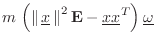
The two cross-products in Eq. (B.19) can be written out with the help
of the vector analysis identityB.23
(B.19) can be written out with the help
of the vector analysis identityB.23
 (B.19),





where
![$\displaystyle \mathbf{I}\underline{\omega}\eqsp
\left[\begin{array}{ccc}
I_{1...
...begin{array}{c} \omega_1 \\ [2pt] \omega_2 \\ [2pt] \omega_3\end{array}\right]
$](http://www.dsprelated.com/josimages_new/pasp/img2872.png)
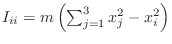 , and
, and
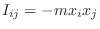 , for
, for
 . That is,

The matrix
 is the Cartesian representation of the mass
moment of inertia tensor, which will be explored further in
§B.4.15 below.
is the Cartesian representation of the mass
moment of inertia tensor, which will be explored further in
§B.4.15 below.
The vector angular momentum of a rigid body is obtained by summing the angular momentum of its constituent mass particles. Thus,

 factors out of the sum, we see that the mass moment of
inertia tensor for a rigid body is given by the sum of the mass moment
of inertia tensors for each of its component mass particles.
factors out of the sum, we see that the mass moment of
inertia tensor for a rigid body is given by the sum of the mass moment
of inertia tensors for each of its component mass particles.
In summary, the angular momentum vector
 is given by the mass
moment of inertia tensor
times the angular-velocity vector
representing the axis of rotation.
is given by the mass
moment of inertia tensor
times the angular-velocity vector
representing the axis of rotation.
Note that the angular momentum vector
does not in general
point in the same direction as the angular-velocity vector
. We
saw above that it does in the special case of a point mass traveling
orthogonal to its position vector. In general,
and
point
in the same direction whenever
is an eigenvector of
, as will be discussed further below (§B.4.16). In this
case, the rigid body is said to be dynamically balanced.B.24
Next Section:
Simple Example
Previous Section:
Relation of Angular to Linear Momentum












