







Characteristic Polynomial Equation
The characteristic polynomial equation for a linear PDE with
constant coefficients is obtained by taking the 2D Laplace transform
of the PDE with respect to  and
and  . A simple way of doing this is
to substitute the general eigensolution
. A simple way of doing this is
to substitute the general eigensolution

into the PDE, where
 denotes the complex variable
associated with the Laplace-transform with respect to time, and
denotes the complex variable
associated with the Laplace-transform with respect to time, and
 is the complex variable associated with the
spatial Laplace transform.
is the complex variable associated with the
spatial Laplace transform.
As a simple example, the ideal-string wave equation (analyzed in §C.1) is a simple second-order PDE given by
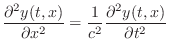
where
 is a positive constant (sound speed, as discussed in
§C.1).
is a positive constant (sound speed, as discussed in
§C.1).
Substituting Eq. (D.6) into Eq.(D.7) results in the following
characteristic polynomial equation:
(D.6) into Eq.(D.7) results in the following
characteristic polynomial equation:
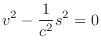
 in terms of
  gives the so-called dispersion
relation:
gives the so-called dispersion
relation:


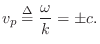 (D.7) must propagate along the string with
speed to either the left or the right along the string. In more
general PDEs, propagation may be dispersive, in which case the
phase velocity depends on frequency (see §C.6 for an
analysis of stiff vibrating strings, which are dispersive). Moreover,
wave propagation may be damped in a frequency-dependent way, in
which case one or more roots of the characteristic polynomial equation
will have negative real parts; if any roots have positive real parts,
we say the initial-value problem is ill posed
since is has exponentially growing solutions in response to initial
conditions.
(D.7) must propagate along the string with
speed to either the left or the right along the string. In more
general PDEs, propagation may be dispersive, in which case the
phase velocity depends on frequency (see §C.6 for an
analysis of stiff vibrating strings, which are dispersive). Moreover,
wave propagation may be damped in a frequency-dependent way, in
which case one or more roots of the characteristic polynomial equation
will have negative real parts; if any roots have positive real parts,
we say the initial-value problem is ill posed
since is has exponentially growing solutions in response to initial
conditions.
Next Section:
Von Neumann Analysis
Previous Section:
Convergence












