







The Dispersive 1D Wave Equation
In the ideal vibrating string, the only restoring force for transverse displacement comes from the string tension (§C.1 above); specifically, the transverse restoring force is equal the net transverse component of the axial string tension. Consider in place of the ideal string a bundle of ideal strings, such as a stranded cable. When the cable is bent, there is now a new restoring force arising from some of the fibers being compressed and others being stretched by the bending. This force sums with that due to string tension. Thus, stiffness in a vibrating string introduces a new restoring force proportional to bending angle. It is important to note that string stiffness is a linear phenomenon resulting from the finite diameter of the string.
In typical treatments,C.3bending stiffness adds a new term to the wave equation that is proportional to the fourth spatial derivative of string displacement:
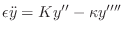
where the moment constant
 is the product of Young's
modulus
is the product of Young's
modulus  (the ``relative-displacement spring constant per unit
cross-sectional area,'' discussed in §B.5.1) and the
area moment of inertia
(the ``relative-displacement spring constant per unit
cross-sectional area,'' discussed in §B.5.1) and the
area moment of inertia  (§B.4.8); as
derived in §B.4.9, a cylindrical string of radius
(§B.4.8); as
derived in §B.4.9, a cylindrical string of radius  has
area moment of inertia equal to
has
area moment of inertia equal to
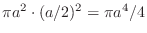 .
This wave equation works well enough for small amounts of bending
stiffness, but it is clearly missing some terms because it predicts
that deforming the string into a parabolic shape will incur no
restoring force due to stiffness. See §6.9 for
further discussion of wave equations for stiff strings.
.
This wave equation works well enough for small amounts of bending
stiffness, but it is clearly missing some terms because it predicts
that deforming the string into a parabolic shape will incur no
restoring force due to stiffness. See §6.9 for
further discussion of wave equations for stiff strings.
To solve the stiff wave equation Eq. (C.32),
we may set
(C.32),
we may set
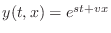 to get
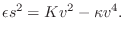
 , we obtain again the non-stiff string:
 .
.
At very high frequencies, or when the tension  is negligible relative
to
is negligible relative
to
 , we obtain the ideal bar (or rod) approximation:

 gives solutions
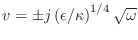 and
and
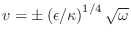 . In the first case, the wave
velocity becomes proportional to
. In the first case, the wave
velocity becomes proportional to
 . That is, waves
travel faster along the ideal bar as oscillation frequency increases,
going up as the square root of frequency. The second solution
corresponds to a change in the wave shape which prevents sharp corners
from forming due to stiffness [95,118].
. That is, waves
travel faster along the ideal bar as oscillation frequency increases,
going up as the square root of frequency. The second solution
corresponds to a change in the wave shape which prevents sharp corners
from forming due to stiffness [95,118].
At intermediate frequencies, between the ideal string and the ideal bar,
the stiffness contribution can be treated as a correction term
[95]. This is the region of most practical interest because
it is the principal operating region for strings, such as piano strings,
whose stiffness has audible consequences (an inharmonic, stretched overtone
series). Assuming
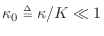 ,
,
 |
 |
 |
|
 |
 |
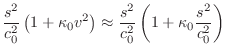 |
|
 |
|
 |
Substituting for
 in terms of
  in
in  gives the general
eigensolution
gives the general
eigensolution
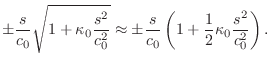
![$\displaystyle e^{st+vx} = \exp{\left\{{s\left[t\pm \frac{x}{c_0}\left(
1+\frac{1}{2}\kappa_0 \frac{s^2}{c_0^2} \right)\right]}\right\}}.
$](http://www.dsprelated.com/josimages_new/pasp/img3398.png) as before, corresponding to driving the medium sinusoidally
over time at frequency
as before, corresponding to driving the medium sinusoidally
over time at frequency  , the medium response is
![$\displaystyle e^{st+vx} = e^{j\omega\left[t\pm {x/ c(\omega)}\right]}
$](http://www.dsprelated.com/josimages_new/pasp/img3399.png)
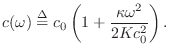 , we cannot use
Fourier's theorem to construct arbitrary traveling shapes by superposition.
At
, we cannot use
Fourier's theorem to construct arbitrary traveling shapes by superposition.
At  , we can construct any function of time, but the waveshape
disperses as it propagates away from . The higher-frequency Fourier
components travel faster than the lower-frequency components.
, we can construct any function of time, but the waveshape
disperses as it propagates away from . The higher-frequency Fourier
components travel faster than the lower-frequency components.
Since the temporal and spatial sampling intervals are related by  , this must generalize to
 , where
  is the size of a unit
delay in the absence of stiffness. Thus, a unit delay
is the size of a unit
delay in the absence of stiffness. Thus, a unit delay  may be
replaced by
may be
replaced by
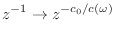 (for frequency-dependent wave velocity).
 denotes the allpass filter which
provides a rational approximation to
denotes the allpass filter which
provides a rational approximation to
 .
.
![\includegraphics[scale=0.9]{eps/fstiffstring}](http://www.dsprelated.com/josimages_new/pasp/img3406.png)
The general, order  , allpass filter is given by [449]
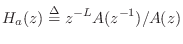

 must all have modulus less than
  .
That is, the numerator polynomial is just the reverse of the
denominator polynomial. This implies each pole
.
That is, the numerator polynomial is just the reverse of the
denominator polynomial. This implies each pole  is
gain-compensated by a zero at
is
gain-compensated by a zero at  .
.
For computability of the string simulation in the presence of scattering
junctions, there must be at least one sample of pure delay along each
uniform section of string. This means for at least one allpass filter in
Fig.C.8, we must have
 which
implies can be factored as
which
implies can be factored as
 . In a
systolic VLSI implementation, it is desirable to have at least one real
delay from the input to the output of every allpass filter, in order
to be able to pipeline the computation of all of the allpass filters in
parallel. Computability can be arranged in practice by deciding on a
minimum delay, (e.g., corresponding to the wave velocity at a maximum
frequency), and using an allpass filter to provide excess delay beyond the
minimum.
. In a
systolic VLSI implementation, it is desirable to have at least one real
delay from the input to the output of every allpass filter, in order
to be able to pipeline the computation of all of the allpass filters in
parallel. Computability can be arranged in practice by deciding on a
minimum delay, (e.g., corresponding to the wave velocity at a maximum
frequency), and using an allpass filter to provide excess delay beyond the
minimum.
Because allpass filters are linear and time invariant, they commute
like gain factors with other linear, time-invariant components.
Fig.C.9 shows a diagram equivalent to
Fig.C.8 in which the allpass filters have been
commuted and consolidated at two points. For computability in all
possible contexts (e.g., when looped on itself), a single sample of
delay is pulled out along each rail. The remaining transfer function,
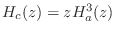 in the example of
Fig.C.9, can be approximated using any allpass filter
design technique
[1,2,267,272,551].
Alternatively, both gain and dispersion for a stretch of waveguide can
be provided by a single filter which can be designed using any
general-purpose filter design method which is sensitive to
frequency-response phase as well as magnitude; examples include
equation error methods (such as used in the matlab invfreqz
function (§8.6.4), and Hankel norm methods
[177,428,36].
in the example of
Fig.C.9, can be approximated using any allpass filter
design technique
[1,2,267,272,551].
Alternatively, both gain and dispersion for a stretch of waveguide can
be provided by a single filter which can be designed using any
general-purpose filter design method which is sensitive to
frequency-response phase as well as magnitude; examples include
equation error methods (such as used in the matlab invfreqz
function (§8.6.4), and Hankel norm methods
[177,428,36].
![\includegraphics[scale=0.9]{eps/flstiffstring}](http://www.dsprelated.com/josimages_new/pasp/img3413.png) |
In the case of a lossless, stiff string, if  denotes the
consolidated allpass transfer function, it can be argued that the filter
design technique used should minimize the phase-delay error, where
phase delay is defined by [362]
denotes the
consolidated allpass transfer function, it can be argued that the filter
design technique used should minimize the phase-delay error, where
phase delay is defined by [362]
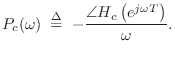 (Phase Delay)
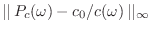
Alternatively, a lumped allpass filter can be designed by minimizing group delay,
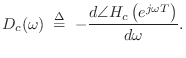 (Group Delay)
, while the
phase delay applies to the ``carrier'' at , or a sinusoidal
component at frequency [342]. As a result, for proper
tuning of overtones, phase delay is what matters, while
for precisely estimating (or controlling) the decay time in a lossy
waveguide, group delay gives the effective filter delay ``seen'' by the
exponential decay envelope.
(Group Delay)
, while the
phase delay applies to the ``carrier'' at , or a sinusoidal
component at frequency [342]. As a result, for proper
tuning of overtones, phase delay is what matters, while
for precisely estimating (or controlling) the decay time in a lossy
waveguide, group delay gives the effective filter delay ``seen'' by the
exponential decay envelope.
See §9.4.1 for designing allpass filters with a prescribed delay versus frequency. To model stiff strings, the allpass filter must supply a phase delay which decreases as frequency increases. A good approximation may require a fairly high-order filter, adding significantly to the cost of simulation. (For low-pitched piano strings, order 8 allpass filters work well perceptually [1].) To a large extent, the allpass order required for a given error tolerance increases as the number of lumped frequency-dependent delays is increased. Therefore, increased dispersion consolidation is accompanied by larger required allpass filters, unlike the case of resistive losses.
The function piano_dispersion_filter in the Faust distribution (in effect.lib) designs and implements an allpass filter modeling the dispersion due to stiffness in a piano string [154,170,368].
Higher Order Terms
The complete, linear, time-invariant generalization of the lossy, stiff string is described by the differential equation
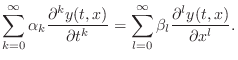
which, on setting
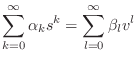
, (or taking the 2D Laplace transform
with zero initial conditions), yields the algebraic equation,
 |
(C.34) |
Solving for
in terms of is, of course, nontrivial in general.
However, in specific cases, we can determine the appropriate
attenuation per sample  and wave propagation speed
 by numerical means. For example, starting at
  , we
normally also have
, we
normally also have  (corresponding to the absence of static
deformation in the medium). Stepping forward by a small
differential
(corresponding to the absence of static
deformation in the medium). Stepping forward by a small
differential
 , the left-hand side can be approximated by
 . Requiring the generalized wave velocity
 to be continuous, a physically reasonable assumption, the
right-hand side can be approximated by
to be continuous, a physically reasonable assumption, the
right-hand side can be approximated by
 , and
the solution is easy. As steps forward, higher order terms become
important one by one on both sides of the equation. Each new term in
spawns a new solution for in terms of , since the order of
the polynomial in is incremented. It appears possible that
homotopy continuation methods [316] can be used to
keep track of the branching solutions of as a function of .
For each solution
, and
the solution is easy. As steps forward, higher order terms become
important one by one on both sides of the equation. Each new term in
spawns a new solution for in terms of , since the order of
the polynomial in is incremented. It appears possible that
homotopy continuation methods [316] can be used to
keep track of the branching solutions of as a function of .
For each solution  , let
, let
 denote the real part of
 and let
 denote the imaginary part. Then the
eigensolution family can be seen in the form
denote the imaginary part. Then the
eigensolution family can be seen in the form
 . Defining
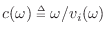 , and
sampling according to
, and
sampling according to
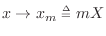 and
and
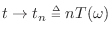 , with
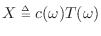 as before, (the spatial sampling
period is taken to be frequency invariant, while the temporal sampling
interval is modulated versus frequency using allpass filters), the
left- and right-going sampled eigensolutions become
as before, (the spatial sampling
period is taken to be frequency invariant, while the temporal sampling
interval is modulated versus frequency using allpass filters), the
left- and right-going sampled eigensolutions become
 |
|
 |
(C.35) |
|
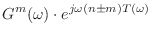 |
where
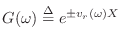 . Thus, a general map of
versus , corresponding to a partial differential equation of any
order in the form (C.33), can be translated, in principle, into an
accurate, local, linear, time-invariant, discrete-time simulation.
The boundary conditions and initial state determine the initial
mixture of the various solution branches as usual.
. Thus, a general map of
versus , corresponding to a partial differential equation of any
order in the form (C.33), can be translated, in principle, into an
accurate, local, linear, time-invariant, discrete-time simulation.
The boundary conditions and initial state determine the initial
mixture of the various solution branches as usual.
We see that a large class of wave equations with constant coefficients, of any order, admits a decaying, dispersive, traveling-wave type solution. Even-order time derivatives give rise to frequency-dependent dispersion and odd-order time derivatives correspond to frequency-dependent losses. The corresponding digital simulation of an arbitrarily long (undriven and unobserved) section of medium can be simplified via commutativity to at most two pure delays and at most two linear, time-invariant filters.
Every linear, time-invariant filter can be expressed as a zero-phase filter in series with an allpass filter. The zero-phase part can be interpreted as implementing a frequency-dependent gain (damping in a digital waveguide), and the allpass part can be seen as frequency-dependent delay (dispersion in a digital waveguide).
Next Section:
Alternative Wave Variables
Previous Section:
A Lossy 1D Wave Equation












