







2D Boundary Conditions
We often wish to find solutions of the 2D wave equation that obey
certain known boundary conditions. An example is transverse
waves on an ideal elastic membrane, rigidly clamped on its boundary to
form a rectangle with dimensions  meters.
Similar to the derivation of Eq. (B.49), we can subtract
the second sinusoidal traveling wave from the first to yield
(B.49), we can subtract
the second sinusoidal traveling wave from the first to yield

 axis. If we restrict the wavenumber
  to the set
  , where
 is any positive integer, then we also satisfy the boundary
condition along the line parallel to the axis at
is any positive integer, then we also satisfy the boundary
condition along the line parallel to the axis at  . Similar
standing waves along will satisfy both boundary conditions along
. Similar
standing waves along will satisfy both boundary conditions along
 and
and  .
.
Note that we can also use products of horizontal and vertical standing waves

 , the
term
, the
term  is simply part of the constant coefficient, and vice
versa.
is simply part of the constant coefficient, and vice
versa.
To build solutions to the wave equation that obey all of the boundary conditions, we can form linear combinations of the above standing-wave products having zero displacement (``nodes'') along all four boundary lines:

where
 (B.50)
are solutions of the wave equation that satisfy the zero boundary
conditions along the rectangle
(B.50)
are solutions of the wave equation that satisfy the zero boundary
conditions along the rectangle  -
- -
- . Since sinusoids at
different frequencies are orthogonal,
the solution building-blocks
. Since sinusoids at
different frequencies are orthogonal,
the solution building-blocks
 are orthogonal under the
inner product
are orthogonal under the
inner product
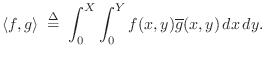 is
complete, that is, that they form a basis for the set of
all solutions to the wave equation satisfying the boundary
conditions. Given that, we can solve the problem of arbitrary
initial conditions. That is, given any initial
is
complete, that is, that they form a basis for the set of
all solutions to the wave equation satisfying the boundary
conditions. Given that, we can solve the problem of arbitrary
initial conditions. That is, given any initial  over the
membrane (subject to the boundary conditions, of course), we can find
the amplitude of each excited mode by simple projection:
over the
membrane (subject to the boundary conditions, of course), we can find
the amplitude of each excited mode by simple projection:
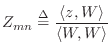 in the desired solution
space is a special case (zero boundary conditions) of the problem of
showing that the 2D Fourier series expansion is complete in the space
of all continuous rectangular surfaces.
in the desired solution
space is a special case (zero boundary conditions) of the problem of
showing that the 2D Fourier series expansion is complete in the space
of all continuous rectangular surfaces.
The Wikipedia page (as of 1/31/10) on the Helmholtz equation provides a nice ``entry point'' on the above topics and further information.
Next Section:
3D Sound
Previous Section:
Solving the 2D Wave Equation












