Solving the 2D Wave Equation
Since solving the wave equation in 2D has all the essential features of the 3D case, we will look at the 2D case in this section.
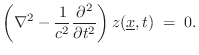
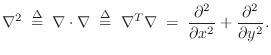
Specializing Eq. (B.47) to 2D, the 2D wave equation may
be written as
(B.47) to 2D, the 2D wave equation may
be written as
The 2D wave equation is obeyed by traveling sinusoidal plane
waves having any amplitude  , radian frequency
  , phase
 , and direction
 :
:
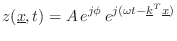
 denotes the vector-wavenumber,
 denotes
the wavenumber (spatial radian frequency) of the wave along its
direction of travel, and
is a unit vector of direction
cosines. This is the analytic-signal form of a sinusoidal
traveling plane wave, and we may define the real (physical) signal as
the real part of the analytic signal, as usual [451].
We see that the only constraint imposed by the wave equation on this
general traveling-wave is the so-called dispersion relation:
denotes
the wavenumber (spatial radian frequency) of the wave along its
direction of travel, and
is a unit vector of direction
cosines. This is the analytic-signal form of a sinusoidal
traveling plane wave, and we may define the real (physical) signal as
the real part of the analytic signal, as usual [451].
We see that the only constraint imposed by the wave equation on this
general traveling-wave is the so-called dispersion relation:
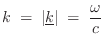
 is tied to its temporal frequency by
the dispersion relation.B.36
is tied to its temporal frequency by
the dispersion relation.B.36
The sum of two such waves traveling in opposite directions with the
same amplitude and frequency produces a standing wave. For example,
if the waves are traveling parallel to the  axis, we have

which is a standing wave along
.
Next Section:
2D Boundary Conditions
Previous Section:
Vector Wavenumber