







2D Mesh and the Wave Equation
 |
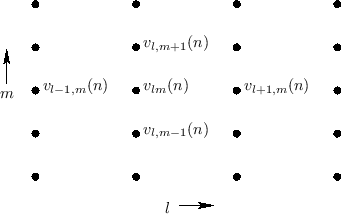
Consider the 2D rectilinear mesh, with nodes at positions  and
and
 , where
  and
and  are integers, and
  and
and  denote the
spatial sampling intervals along
denote the
spatial sampling intervals along  and
and  , respectively
(see Fig.C.33).
Then from
Eq.
, respectively
(see Fig.C.33).
Then from
Eq. (C.105) the junction velocity
  at time
  is given
by
is given
by
![$\displaystyle v_{lm}(n) =
\frac{1}{2}\left[
v_{lm}^{+\textsc{n}}(n) +
v_{lm}^{+\textsc{e}}(n) +
v_{lm}^{+\textsc{s}}(n) +
v_{lm}^{+\textsc{w}}(n)\right]
$](http://www.dsprelated.com/josimages_new/pasp/img4017.png)
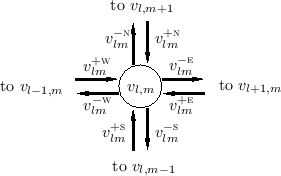
 is the ``incoming wave from the north'' to
node
is the ``incoming wave from the north'' to
node  , and similarly for the waves coming from east, west, and
south (see Fig.C.34).
, and similarly for the waves coming from east, west, and
south (see Fig.C.34).
These incoming traveling-wave components arrive from the four
neighboring nodes after a one-sample propagation delay. For example,
, arriving from the north, departed from node
 at time
  , as
, as
 .
Furthermore, the outgoing components at time
will arrive at the neighboring nodes
one sample in the future at time
.
Furthermore, the outgoing components at time
will arrive at the neighboring nodes
one sample in the future at time  .
For example,
.
For example,
 will become
 .
Using these relations, we can
write
.
Using these relations, we can
write
 in terms of the four outgoing waves from its
neighbors at time :
in terms of the four outgoing waves from its
neighbors at time :
![$\displaystyle v_{lm}(n+1) = \frac{1}{2}\left[ v_{l,m+1}^{-\textsc{s}}(n) + v_{l...
...}}(n) + v_{l,m-1}^{-\textsc{n}}(n) + v_{l-1,m}^{-\textsc{e}}(n)\right] \protect$](http://www.dsprelated.com/josimages_new/pasp/img4024.png)
where, for instance,
is the ``outgoing wave to the
north'' from node . Similarly, the outgoing waves leaving
 become the incoming traveling-wave components of its
neighbors at time :
become the incoming traveling-wave components of its
neighbors at time :
![$\displaystyle v_{lm}(n-1) = \frac{1}{2}\left[ v_{l,m+1}^{+\textsc{s}}(n) + v_{l...
...}}(n) + v_{l,m-1}^{+\textsc{n}}(n) + v_{l-1,m}^{+\textsc{e}}(n)\right] \protect$](http://www.dsprelated.com/josimages_new/pasp/img4026.png)
This may be shown in detail by writing
![\begin{eqnarray*}
v_{lm}(n-1)
&=& \frac{1}{2}[v_{lm}^{+\textsc{n}}(n-1) + \cdot...
...}^{-\textsc{n}}(n-1) + \cdots + v_{lm}^{-\textsc{w}}(n-1)\right]
\end{eqnarray*}](http://www.dsprelated.com/josimages_new/pasp/img4027.png)
so that
![\begin{eqnarray*}
v_{lm}(n-1)
&=& \frac{1}{2}[v_{lm}^{-\textsc{n}}(n-1) + \cdot...
...
v_{l,m-1}^{+\textsc{n}}(n) +
v_{l-1,m}^{+\textsc{e}}(n)\right].
\end{eqnarray*}](http://www.dsprelated.com/josimages_new/pasp/img4028.png)
Adding Equations (C.116-C.116), replacing
terms such as
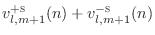 with
with
 , yields a computation in terms of physical node velocities:
![\begin{eqnarray*}
\lefteqn{v_{lm}(n+1) + v_{lm}(n-1) = } \\
& & \frac{1}{2}\left[
v_{l,m+1}(n) +
v_{l+1,m}(n) +
v_{l,m-1}(n) +
v_{l-1,m}(n)\right]
\end{eqnarray*}](http://www.dsprelated.com/josimages_new/pasp/img4031.png)
Thus, the rectangular waveguide mesh satisfies this equation
giving a formula for the velocity at node , in terms of
the velocity at its neighboring nodes one sample earlier, and itself
two samples earlier. Subtracting
 from both sides yields
![\begin{eqnarray*}
\lefteqn{v_{lm}(n+1) - 2 v_{lm}(n) + v_{lm}(n-1)} \\
&=& \fra...
.... \left[v_{l+1,m}(n) - 2 v_{lm}(n) + v_{l-1,m}(n)\right]\right\}
\end{eqnarray*}](http://www.dsprelated.com/josimages_new/pasp/img4033.png)
Dividing by the respective sampling intervals, and assuming  (square mesh-holes), we obtain
![\begin{eqnarray*}
\lefteqn{\frac{v_{lm}(n+1) - 2 v_{lm}(n) + v_{lm}(n-1)}{T^2}} ...
...ft.\frac{v_{l+1,m}(n) - 2 v_{lm}(n) + v_{l-1,m}(n)}{X^2}\right].
\end{eqnarray*}](http://www.dsprelated.com/josimages_new/pasp/img4035.png)
In the limit, as the sampling intervals  approach zero such that
 remains
constant, we recognize these expressions as the definitions of the partial
derivatives with respect to
remains
constant, we recognize these expressions as the definitions of the partial
derivatives with respect to  , , and , respectively, yielding
![$\displaystyle \frac{\partial^2 v(t,x,y)}{\partial t^2} = \frac{X^2}{2T^2}
\left...
...^2 v(t,x,y)}{\partial x^2}
+ \frac{\partial^2 v(t,x,y)}{\partial y^2}
\right].
$](http://www.dsprelated.com/josimages_new/pasp/img4038.png)
 , i.e.,
![$\displaystyle \frac{\partial^2 v}{\partial t^2} =
c^2
\left[
\frac{\partial^2 v}{\partial x^2}
+ \frac{\partial^2 v}{\partial y^2}
\right]
$](http://www.dsprelated.com/josimages_new/pasp/img4040.png)
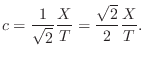
Discussion regarding solving the 2D wave equation subject to boundary conditions appears in §B.8.3. Interpreting this value for the wave propagation speed
 , we see that
every two time steps of
, we see that
every two time steps of  seconds corresponds to a spatial step
of
seconds corresponds to a spatial step
of  meters.
This is the distance from one diagonal to the
next in the square-hole mesh. We will show later that diagonal
directions on the mesh support exact propagation (of plane
waves traveling at 45-degree angles with respect to the or
axes). In the and directions, propagation is highly
dispersive, meaning that different frequencies travel at
different speeds. The exactness of 45-degree angles can be
appreciated by considering Huygens' principle on the mesh.
meters.
This is the distance from one diagonal to the
next in the square-hole mesh. We will show later that diagonal
directions on the mesh support exact propagation (of plane
waves traveling at 45-degree angles with respect to the or
axes). In the and directions, propagation is highly
dispersive, meaning that different frequencies travel at
different speeds. The exactness of 45-degree angles can be
appreciated by considering Huygens' principle on the mesh.
Next Section:
The Lossy 2D Mesh
Previous Section:
Recent Developments












