Doppler Effect
The Doppler effect causes the pitch of a sound source to appear to rise or fall due to motion of the source and/or listener relative to each other. You have probably heard the pitch of a horn drop lower as it passes by (e.g., from a moving train). As a pitched sound-source moves toward you, the pitch you hear is raised; as it moves away from you, the pitch is lowered. The Doppler effect has been used to enhance the realism of simulated moving sound sources for compositional purposes [80], and it is an important component of the ``Leslie effect'' (described in §5.9).
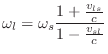
As derived in elementary physics texts, the Doppler shift is given by
where
 is the radian frequency emitted by the source at rest,
 is the frequency received by the listener,
  denotes the
speed of the listener relative to the propagation medium in the
direction of the source,
denotes the
speed of the listener relative to the propagation medium in the
direction of the source,  denotes the speed of the source
relative to the propagation medium in the direction of the listener,
and
denotes the speed of the source
relative to the propagation medium in the direction of the listener,
and  denotes sound speed. Note that all quantities in this formula
are scalars.
denotes sound speed. Note that all quantities in this formula
are scalars.
Vector Formulation
Denote the sound-source velocity by
 where
where
 is time. Similarly,
let
is time. Similarly,
let
 denote the velocity of the listener, if any. The
position of source and listener are denoted
denote the velocity of the listener, if any. The
position of source and listener are denoted
 and
and
 , respectively, where
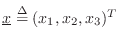 is 3D
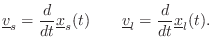
position. We have velocity related to position by
is 3D
position. We have velocity related to position by
Consider a Fourier component of the source at frequency
. We
wish to know how this frequency is shifted to at the listener
due to the Doppler effect.
The Doppler effect depends only on velocity components along the line
connecting the source and listener [349, p. 453]. We may
therefore orthogonally project the source and listener
velocities onto the vector
 pointing from the source
to the listener. (See Fig.5.8 for a specific example.)
pointing from the source
to the listener. (See Fig.5.8 for a specific example.)
The orthogonal projection of a vector
 onto a vector
 is given by [451]


In the far field (listener far away), Eq.
 (5.4) reduces to

Next Section:
Doppler Simulation
Previous Section:
Vibrato Simulation