General Nonlinear ODE
In state-space form (§1.3.7) [449],8.7a general class of  th-order Ordinary Differential Equations (ODE),
can be written as
th-order Ordinary Differential Equations (ODE),
can be written as
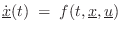
where
 denotes time in seconds,
 denotes a vector of
state variables at time ,
denotes a vector of
state variables at time ,
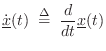 , and
, and
 is a vector (any
length) of the system input signals, if any. Thus, Eq.
is a vector (any
length) of the system input signals, if any. Thus, Eq. (7.8) says
simply that the time-derivative of the state vector is some function
(7.8) says
simply that the time-derivative of the state vector is some function
 depending on time , the current state
, and the current
input signals
. The basic problem is to solve for the state
trajectory
given its initial condition
depending on time , the current state
, and the current
input signals
. The basic problem is to solve for the state
trajectory
given its initial condition
 , the system
definition function , and the input signals
for all
, the system
definition function , and the input signals
for all  .
.
In the linear, time-invariant (LTI) case, Eq.(7.8) can be
expressed in the usual state-space form for LTI continuous-time
systems:
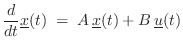
In this case, standard methods for converting a filter from continuous to discrete time may be used, such as the FDA (§7.3.1) and bilinear transform (§7.3.2).8.8
Next Section:
Forward Euler Method
Previous Section:
Limitations of Lumped Element Digitization