Finite Difference Approximation
A finite difference approximation (FDA) approximates derivatives with finite differences, i.e.,
![$\displaystyle \frac{d}{dt} x(t) \isdefs \lim_{\delta\to 0} \frac{x(t) - x(t-\delta)}{\delta} \;\approx\; \frac{x(n T)-x[(n-1)T]}{T} \protect$](http://www.dsprelated.com/josimages_new/pasp/img1643.png)
for sufficiently small
 .8.5
.8.5
Equation (7.2) is also known as the backward difference approximation of differentiation.
See §C.2.1 for a discussion of using the FDA to model ideal vibrating strings.
FDA in the Frequency Domain
Viewing Eq. (7.2) in the frequency domain, the ideal
differentiator transfer-function is
(7.2) in the frequency domain, the ideal
differentiator transfer-function is  , which can be viewed as
the Laplace transform of the operator
, which can be viewed as
the Laplace transform of the operator  (left-hand side of
Eq.(7.2)). Moving to the right-hand side, the z transform of the
first-order difference operator is
(left-hand side of
Eq.(7.2)). Moving to the right-hand side, the z transform of the
first-order difference operator is
 . Thus, in the
frequency domain, the finite-difference approximation may be performed
by making the substitution
. Thus, in the
frequency domain, the finite-difference approximation may be performed
by making the substitution
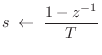
in any continuous-time transfer function (Laplace transform of an integro-differential operator) to obtain a discrete-time transfer function (z transform of a finite-difference operator).
The inverse of substitution Eq.(7.3) is

As discussed in §8.3.1, the FDA is a special case of the
matched  transformation applied to the point
  .
.
Note that the FDA does not alias, since the conformal mapping
 is one to one. However, it does warp the poles and zeros in a
way which may not be desirable, as discussed further on p.
is one to one. However, it does warp the poles and zeros in a
way which may not be desirable, as discussed further on p. ![[*]](../icons/crossref.png) below.
below.
Delay Operator Notation
It is convenient to think of the FDA in terms of time-domain
difference operators using a delay operator notation. The
delay operator  is defined by
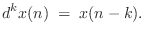
 . We can think of as
 since, by the shift theorem for transforms,
 is the transform of
  delayed (right shifted) by
  samples.
The obvious definition for the second derivative is
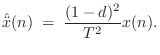
However, a better definition is the centered finite difference

where
 denotes a unit-sample advance. This definition
is preferable as long as one sample of look-ahead is available, since
it avoids an operator delay of one sample. Equation (7.5) is a
zero phase filter, meaning it has no delay at any frequency,
while (7.4) is a linear phase filter having a delay of
denotes a unit-sample advance. This definition
is preferable as long as one sample of look-ahead is available, since
it avoids an operator delay of one sample. Equation (7.5) is a
zero phase filter, meaning it has no delay at any frequency,
while (7.4) is a linear phase filter having a delay of
 sample at all frequencies.
Next Section:
Bilinear Transformation
Previous Section:
Passive One-Ports