Longitudinal Waves in Rods
In this section, elementary scattering relations will be derived for the case of longitudinal force and velocity waves in an ideal string or rod. In solids, force-density waves are referred to as stress waves [169,261]. Longitudinal stress waves in strings and rods have units of (compressive) force per unit area and are analogous to longitudinal pressure waves in acoustic tubes.
![\includegraphics[width=\twidth]{eps/Fwgfs}](http://www.dsprelated.com/josimages_new/pasp/img3577.png) |
 . The behavior at an
A single waveguide section between two partial sections is shown in
Fig.C.19. The sections are numbered 0 through  from
left to right, and their wave impedances are
from
left to right, and their wave impedances are  ,
,  , and
, and  ,
respectively. Such a rod might be constructed, for example, using
three different materials having three different densities. In the
,
respectively. Such a rod might be constructed, for example, using
three different materials having three different densities. In the
 th section, there are two stress traveling waves:
  traveling
to the right at speed
traveling
to the right at speed  , and
, and  traveling to the left at speed
. To minimize the numerical dynamic range, velocity waves may be
chosen instead when
traveling to the left at speed
. To minimize the numerical dynamic range, velocity waves may be
chosen instead when  .
.
As in the case of transverse waves (see the derivation of (C.46)), the traveling longitudinal plane waves in each section satisfy [169,261]
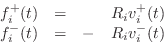
where the wave impedance is now
 , with
  being
the mass density, and
being
the mass density, and  being the Young's modulus of the
medium (defined as the stress over the strain, where strain
means relative displacement--see §B.5.1)
[169,261]. As before, velocity
being the Young's modulus of the
medium (defined as the stress over the strain, where strain
means relative displacement--see §B.5.1)
[169,261]. As before, velocity
 is defined
as positive to the right, and is the right-going traveling-wave
component of the stress, and it is positive when the rod is locally
compressed.
is defined
as positive to the right, and is the right-going traveling-wave
component of the stress, and it is positive when the rod is locally
compressed.
If the wave impedance  is constant, the shape of a traveling wave
is not altered as it propagates from one end of a rod-section to the
other. In this case we need only consider and at one
end of each section as a function of time. As shown in Fig.C.19,
we define
is constant, the shape of a traveling wave
is not altered as it propagates from one end of a rod-section to the
other. In this case we need only consider and at one
end of each section as a function of time. As shown in Fig.C.19,
we define
 as the force-wave component at the extreme
left of section . Therefore, at the extreme right of section ,
we have the traveling waves
as the force-wave component at the extreme
left of section . Therefore, at the extreme right of section ,
we have the traveling waves
 and
and
 , where
  is
the travel time from one end of a section to the other.
is
the travel time from one end of a section to the other.
For generality, we may allow the wave impedances to vary with
time. A number of possibilities exist which satisfy (C.57) in the
time-varying case. For the moment, we will assume the traveling waves
at the extreme right of section are still given by
and
. This definition, however, implies the velocity varies
inversely with the wave impedance. As a result, signal energy, being the product
of force times velocity, is ``pumped'' into or out of the waveguide
by a changing wave impedance. Use of normalized waves
 avoids this.
However, normalization increases the required number of
multiplications, as we will see in §C.8.6 below.
avoids this.
However, normalization increases the required number of
multiplications, as we will see in §C.8.6 below.
As before, the physical force density (stress) and velocity at the
left end of section are obtained by summing the left- and
right-going traveling wave components:


Let
 denote the force at position
  and time
  in
section , where
in
section , where
![$ x_i\in[0,cT]$](http://www.dsprelated.com/josimages_new/pasp/img3594.png) is measured from the extreme left of
section along its axis. Then we have, for example,
is measured from the extreme left of
section along its axis. Then we have, for example,
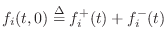 and
and
 at the boundaries of section .
More generally, within section , the physical stress may be expressed
in terms of its traveling-wave components by
at the boundaries of section .
More generally, within section , the physical stress may be expressed
in terms of its traveling-wave components by

Next Section:
Kelly-Lochbaum Scattering Junctions
Previous Section:
Plane-Wave Scattering at an Angle