







Momentum Conservation in Nonuniform Tubes
Newton's second law ``force equals mass times acceleration'' implies that
the pressure gradient in a gas is proportional to the acceleration of a
differential volume element in the gas. Let  denote the area of the
surface of constant phase at radial coordinate
denote the area of the
surface of constant phase at radial coordinate  in the tube. Then the
total force acting on the surface due to pressure is
in the tube. Then the
total force acting on the surface due to pressure is
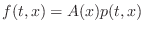 , as
shown in Fig.C.45.
, as
shown in Fig.C.45.
![\includegraphics[width=3in]{eps/fconic}](http://www.dsprelated.com/josimages_new/pasp/img4265.png)
The net force  to the right across the volume element
between and
to the right across the volume element
between and  is then
 |
 |
![$\displaystyle f(t,x)-[f(t,x) + dx \cdot f'(x)]$](http://www.dsprelated.com/josimages_new/pasp/img4269.png) |
|
|
 |
||
|
![$\displaystyle - dx \cdot[A(x)p(t,x)]'$](http://www.dsprelated.com/josimages_new/pasp/img4271.png) |
||
|
![$\displaystyle -dx \cdot[A' p + A'p],$](http://www.dsprelated.com/josimages_new/pasp/img4272.png) |
where, when time and/or position arguments have been dropped, as in the last line above, they are all understood to be
 and ,
respectively. To apply Newton's second law equating net force to mass
times acceleration, we need the mass of the volume element
and ,
respectively. To apply Newton's second law equating net force to mass
times acceleration, we need the mass of the volume element
![\begin{eqnarray*}
dM(t,x) &=& \int_x^{x+dx} \rho(t,\xi) A(\xi)\,d\xi \\ [5pt]
&\...
...\rho A' \right)\frac{(dx)^2}{2}\\ [5pt]
&\approx& \rho\, A\,dx,
\end{eqnarray*}](http://www.dsprelated.com/josimages_new/pasp/img4273.png)
where  denotes air density.
The center-of-mass acceleration of the volume element can be written
as
 where
where  is particle velocity.C.16 Applying Newton's second law
 , we
obtain
, we
obtain

or, dividing through by
 ,
,
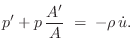
In terms of the logarithmic derivative of
 , this can be written
 ln
ln
Note that
 denotes small-signal acoustic pressure, while
 denotes the full gas density (not just an acoustic perturbation
in the density). We may therefore treat as a constant.
denotes the full gas density (not just an acoustic perturbation
in the density). We may therefore treat as a constant.
Cylindrical Tubes
In the case of cylindrical tubes, the logarithmic derivative of the
area variation,
ln , is zero, and Eq.
 (C.148)
reduces to the usual momentum conservation equation
(C.148)
reduces to the usual momentum conservation equation
 encountered when deriving the wave equation for plane waves
[318,349,47]. The present case reduces to the
cylindrical case when
encountered when deriving the wave equation for plane waves
[318,349,47]. The present case reduces to the
cylindrical case when

If we look at sinusoidal spatial waves,
 and
and
 , then
 and
and
 , and the condition
for cylindrical-wave behavior becomes
, and the condition
for cylindrical-wave behavior becomes
 , i.e., the spatial
frequency of the wall variation must be much less than that of the
wave. Another way to say this is that the wall must be approximately
flat across a wavelength. This is true for smooth horns/bores at
sufficiently high wave frequencies.
, i.e., the spatial
frequency of the wall variation must be much less than that of the
wave. Another way to say this is that the wall must be approximately
flat across a wavelength. This is true for smooth horns/bores at
sufficiently high wave frequencies.
Next Section:
Wave Impedance in a Cone
Previous Section:
Conical Acoustic Tubes












