Time-Varying Delay-Line Reads
If  denotes the input to a time-varying delay, the output can be
written as
denotes the input to a time-varying delay, the output can be
written as
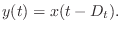
 denotes the time-varying delay in seconds. In
discrete-time implementations, when is not an integer multiple
of the sampling interval,
denotes the time-varying delay in seconds. In
discrete-time implementations, when is not an integer multiple
of the sampling interval,  may be approximated to arbitrary
accuracy (in a finite band) using bandlimited interpolation
(see §4.4) or other techniques for implementation of
fractional delay [267,383].
may be approximated to arbitrary
accuracy (in a finite band) using bandlimited interpolation
(see §4.4) or other techniques for implementation of
fractional delay [267,383].
Let's analyze the frequency shift caused by a time-varying delay by
setting to a complex sinusoid at frequency  :
:



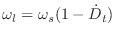
where
 denotes the output frequency, and
 denotes the time derivative
of the delay . Thus, the delay growth-rate,
denotes the time derivative
of the delay . Thus, the delay growth-rate,
 , equals the relative frequency downshift:

Comparing Eq. (5.6) to Eq.(5.2), we find that the
time-varying delay most naturally simulates Doppler shift caused by a
moving listener, with
(5.6) to Eq.(5.2), we find that the
time-varying delay most naturally simulates Doppler shift caused by a
moving listener, with

That is, the delay growth-rate,
, should be set to the speed of
the listener away from the source, normalized by sound speed
 .
.
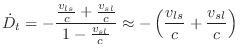
Simulating source motion is also possible, but the relation
between delay change and desired frequency shift is more complex, viz.,
from Eq.(5.2) and Eq.(5.6),
 . In Section
5.7.4, a simplified approach is proposed based on moving the
delay input instead of its output.
. In Section
5.7.4, a simplified approach is proposed based on moving the
delay input instead of its output.
The time-varying delay line was described in §5.1. As discussed there, to implement a continuously varying delay, we add a ``delay growth parameter'' g to the delayline function in Fig.5.1, and change the line
rptr += 1; // pointer updateto
rptr += 1 - g; // pointer updateWhen g is 0, we have a fixed delay line, corresponding to
 in Eq.(5.6). When
 , the delay grows
 samples per sample, which we may also interpret as
seconds per second, i.e.,
samples per sample, which we may also interpret as
seconds per second, i.e.,
 . By Eq.(5.7), we see
that we need
. By Eq.(5.7), we see
that we need

 .
.
Note that when the read- and write-pointers are driven directly from a model of physical propagation-path geometry, they are always separated by predictable minimum and maximum delay intervals. This implies it is unnecessary to worry about the read-pointer passing the write-pointers or vice versa. In generic frequency shifters [275], or in a Doppler simulator not driven by a changing geometry, a pointer cross-fade scheme may be necessary when the read- and write-pointers get too close to each other.
Next Section:
Multiple Read Pointers
Previous Section:
Doppler Simulation via Delay Lines