Infinite Flatness at Infinity
The Gaussian is infinitely flat at infinity. Equivalently, the
Maclaurin expansion (Taylor expansion about  ) of
) of
 |
(D.3) |
is zero for all orders. Thus, even though
 is
differentiable of all orders at
, its series expansion fails to
approach the function. This happens because
is
differentiable of all orders at
, its series expansion fails to
approach the function. This happens because  has an
essential singularity at
has an
essential singularity at  (also called a
``non-removable singularity''). One can think of an essential
singularity as an infinite number of poles piled up at the same
point (
for
). Equivalently,
above has an
infinite number of zeros at
, leading to the problem with
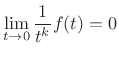
Maclaurin series expansion. To prove this, one can show
(also called a
``non-removable singularity''). One can think of an essential
singularity as an infinite number of poles piled up at the same
point (
for
). Equivalently,
above has an
infinite number of zeros at
, leading to the problem with
Maclaurin series expansion. To prove this, one can show
 |
(D.4) |
for all
 . This follows from the fact that exponential
growth or decay is faster than polynomial growth or decay. An
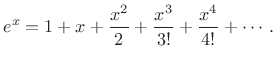
exponential can in fact be viewed as an infinite-order polynomial,
since
. This follows from the fact that exponential
growth or decay is faster than polynomial growth or decay. An
exponential can in fact be viewed as an infinite-order polynomial,
since
 |
(D.5) |
We may call
 infinitely flat at
in the ``Padé sense'':
infinitely flat at
in the ``Padé sense'':
- Padé approximation is maximally flat approximation, and seeks
to use all
 degrees of freedom in the approximation to match
the
leading terms of the Taylor series expansion.
degrees of freedom in the approximation to match
the
leading terms of the Taylor series expansion.
- Butterworth filters (IIR) are maximally flat at dc [263].
- Lagrange interpolation (FIR) is maximally flat at dc [266].
- Thiran allpass interpolation has maximally flat group delay at dc [266].
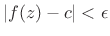
Another interesting mathematical property of essential singularities is
that near an essential singular point
 the
inequality
the
inequality
 |
(D.6) |
is satisfied at some point
 in every neighborhood of
 , however small. In other words,
  comes arbitrarily close
to every possible value in any neighborhood about an
essential singular point. This was first proved by Weierstrass
[42, p. 270].
comes arbitrarily close
to every possible value in any neighborhood about an
essential singular point. This was first proved by Weierstrass
[42, p. 270].
Next Section:
Integral of a Complex Gaussian
Previous Section:
Fitting a Gaussian to Data