







Lossless Filter Examples
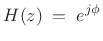
The simplest lossless filter is a unit-modulus gain
 |
(12.82) |
where
 can be any phase value. In the real case
can only be 0
or
can be any phase value. In the real case
can only be 0
or  , hence
 .
.
A lossless FIR filter can only consist of a single nonzero tap:
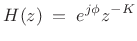
for some fixed integer
 , where
is again some constant phase,
constrained to be 0
or
in the real-filter case.
We consider only causal filters here, so
, where
is again some constant phase,
constrained to be 0
or
in the real-filter case.
We consider only causal filters here, so  .
.
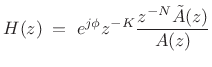
Every finite-order, single-input, single-output (SISO), lossless IIR filter (recursive allpass filter) can be written as
 |
(12.84) |
where
,
 , and
, and
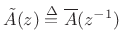 . The polynomial
 can be obtained by reversing the order of the coefficients in
  ,
conjugating them, and multiplying by
,
conjugating them, and multiplying by  . (The factor
  above
serves to restore negative powers of
above
serves to restore negative powers of  and hence causality.) Such
filters are generally called allpass filters.
and hence causality.) Such
filters are generally called allpass filters.
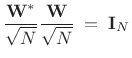
The normalized DFT matrix is an  order zero paraunitary
transformation. This is because the normalized DFT matrix,
order zero paraunitary
transformation. This is because the normalized DFT matrix,
![$ \bold{W}=[W_N^{nk}]/\sqrt{N}$](http://www.dsprelated.com/josimages_new/sasp2/img2198.png) ,
,
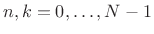 , where
 , is a unitary matrix:
 |
(12.85) |
Next Section:
Properties of Paraunitary Filter Banks
Previous Section:
Lossless Filters












