







Minimum Zero-Padding for High-Frequency Peaks
|
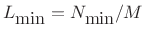 for keeping peak-frequency
  denotes the minimum
  zeros.
 is calculated using the formulas
in [
is calculated using the formulas
in [ (%)
(%)


Table 5.3 gives zero-padding factors sufficient for keeping
the bias below
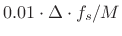 Hz, where
  denotes the sampling
rate in Hz, and
denotes the sampling
rate in Hz, and  is the window length in samples. For fundamental
frequency estimation,
is the window length in samples. For fundamental
frequency estimation,  can be interpreted as the
relative frequency error ``
can be interpreted as the
relative frequency error ``
 '' when the window
length is one period. In this case,
'' when the window
length is one period. In this case,  is the fundamental
frequency in Hz. More generally,
is the bandwidth of each
side-lobe in the DTFT of a length
rectangular, generalized
Hamming, or Blackman window (any member of the Blackman-Harris window
family, as elaborated in Chapter 3).
is the fundamental
frequency in Hz. More generally,
is the bandwidth of each
side-lobe in the DTFT of a length
rectangular, generalized
Hamming, or Blackman window (any member of the Blackman-Harris window
family, as elaborated in Chapter 3).
Note from Table 5.3 that the Blackman window requires no
zero-padding at all when only  % accuracy is required in
peak-frequency measurement. It should also be understood that a
frequency error of
% accuracy is required in
peak-frequency measurement. It should also be understood that a
frequency error of  % is inaudible in most audio
applications.6.10
% is inaudible in most audio
applications.6.10
Next Section:
Minimum Zero-Padding for Low-Frequency Peaks
Previous Section:
Matlab for Parabolic Peak Interpolation












