







Optimized Windows
We close this chapter with a general discussion of optimal windows in a wider sense. We generally desire
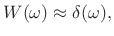 |
(4.59) |
but the nature of this approximation is typically determined by characteristics of audio perception. Best results are usually obtained by formulating this as an FIR filter design problem (see Chapter 4). In general, both time-domain and frequency-domain specifications are needed. (Recall the potentially problematic impulses in the Dolph-Chebyshev window shown in Fig.3.33 when its length was long and ripple level was high). Equivalently, both magnitude and phase specifications are necessary in the frequency domain.
A window transform can generally be regarded as the frequency response
of a lowpass filter having a stop band corresponding to
the side lobes and a pass band corresponding to the main lobe
(or central section of the main lobe). Optimal lowpass filters
require a transition region from the pass band to the stop
band. For spectrum analysis windows, it is natural to define the
entire main lobe as ``transition region.'' That is, the
pass-band width is zero. Alternatively, the pass-band could be
allowed to have a finite width, allowing some amount of ``ripple'' in
the pass band; in this case, the pass-band ripple will normally be
maximum at the main-lobe midpoint (
 , say), and at the
pass-band edges (
, say), and at the
pass-band edges (
 ). By
embedding the window design problem within the more general problem of
FIR digital filter design, a plethora of optimal design techniques can
be brought to bear
[204,258,14,176,218].
). By
embedding the window design problem within the more general problem of
FIR digital filter design, a plethora of optimal design techniques can
be brought to bear
[204,258,14,176,218].
Optimal Windows for Audio Coding
Recently, numerically optimized windows have been developed by Dolby which achieve the following objectives:
- Narrow the window in time
- Smooth the onset and decay in time
- Reduce side lobes below the worst-case masking threshold
See §4.10 for an overview of optimal methods for FIR digital filter design.
General Rule
There is rarely a closed form expression for the optimal window in
practice. The most important task is to formulate an ideal
error criterion. Given the right error criterion, it is usually
straightforward to minimize it numerically with respect to the window
samples  .
.
Next Section:
Window Design by Linear Programming
Previous Section:
Gaussian Window and Transform












