Summary
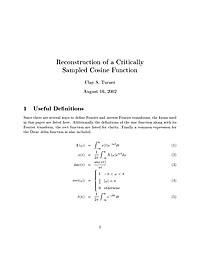
This paper analyzes when and how a single-tone cosine sampled at a critically low (minimum) rate can be uniquely reconstructed, identifying ambiguity and aliasing conditions. It presents FFT-based and parametric reconstruction methods, filter design recommendations, and statistical analysis of noise effects to guide practical implementations.
Key Takeaways
- Determine the sampling conditions and frequency relationships that permit unique reconstruction of a critically sampled cosine versus those that cause aliasing ambiguities.
- Apply FFT-based spectral techniques to locate aliased spectral lines and to form initial estimates of frequency, amplitude, and phase.
- Design minimal interpolation or reconstruction filters and choose parametric estimators (e.g., sinusoid fitting) to recover amplitude and phase accurately from critically sampled data.
- Assess the impact of noise and sampling jitter on estimator variance and bias using statistical measures and Cramér–Rao-type bounds.
Who Should Read This
Advanced DSP engineers, researchers, and signal-processing practitioners focused on sampling theory, spectral estimation, or reconstruction of sinusoidal signals in communications and measurement systems.
TimelessAdvanced
Related Documents
- A New Approach to Linear Filtering and Prediction Problems TimelessAdvanced
- A Quadrature Signals Tutorial: Complex, But Not Complicated TimelessIntermediate
- An Introduction To Compressive Sampling TimelessIntermediate
- Lecture Notes on Elliptic Filter Design TimelessAdvanced
- Computing FFT Twiddle Factors TimelessAdvanced