







DSPRelated.com
Computing Translated Frequencies in Digitizing  and Downsampling Analog Bandpass Signals

Computing Translated Frequencies in Digitizing and Downsampling Analog Bandpass Signals

Rick Lyons
TimelessAdvanced

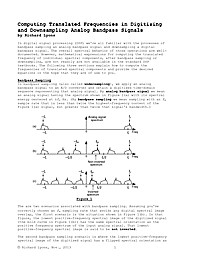
In digital signal processing (DSP) we're all familiar with the processes of bandpass sampling an analog bandpass signal and downsampling a digital bandpass signal. The overall spectral behavior of those operations are well-documented. However, mathematical expressions for computing the translated frequency of individual spectral components, after bandpass sampling or downsampling, are not available in the standard DSP textbooks. This document explains how to compute the frequencies of translated spectral components and provide the desired equations in the hope that they are of use to you.


Summary

This paper explains how to compute the translated digital frequencies of individual spectral components that result from bandpass sampling an analog signal or downsampling a digital bandpass signal. It provides closed-form equations and worked examples so practitioners can predict aliasing, frequency folding, and spectral inversion precisely rather than relying on qualitative plots.

Key Takeaways

  • Compute the translated digital frequency of an analog spectral component after bandpass sampling using closed-form equations.
  • Predict aliasing, folding, and spectral inversion outcomes when downsampling bandpass signals.
  • Apply mapping formulas to choose sampling and decimation rates that avoid unwanted spectral overlap.
  • Use worked examples to map continuous-time frequencies to discrete-time bins for analysis and implementation.

Who Should Read This

Intermediate-to-advanced engineers and researchers in communications, radar, or DSP algorithm development who need exact formulas to predict how spectral components translate under bandpass sampling and digital downsampling.

TimelessAdvanced

Topics

FFT/Spectral AnalysisMultirate SystemsCommunicationsRadar

Related Documents








