







DSPRelated.com
Generating Complex Baseband and Analytic Bandpass Signals

Generating Complex Baseband and Analytic Bandpass Signals

Rick Lyons
TimelessIntermediate

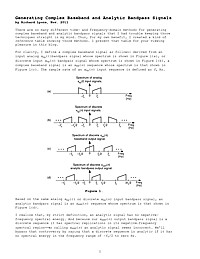
There are so many different time- and frequency-domain methods for generating complex baseband and analytic bandpass signals that I had trouble keeping those techniques straight in my mind. Thus, for my own benefit, I created a kind of reference table showing those methods. I present that table for your viewing pleasure in this document.


Summary

Rick Lyons provides a compact reference table that organizes the many time- and frequency-domain methods for producing complex baseband and analytic bandpass signals. The paper helps engineers compare approaches such as Hilbert-transform filters, complex mixing (quadrature) methods, and FFT-based constructions to understand implementation tradeoffs and use cases.

Key Takeaways

  • Compare time-domain Hilbert-transform FIRs and frequency-domain/FFT methods for constructing analytic signals and their computational tradeoffs.
  • Implement complex baseband conversion via quadrature mixing, digital downconversion, and discrete-time frequency translation.
  • Design analytic bandpass filters and FIR Hilbert transformers with guidance on phase response, length, and ripple tradeoffs.
  • Apply FFT-based spectral shifting and analytic reconstruction for offline processing and large-block spectral operations.
  • Assess practical considerations like numerical precision, aliasing, and real-to-complex conversion for real-time DSP implementation.

Who Should Read This

Intermediate DSP engineers, radar/communications practitioners, and graduate students who need a concise, practical reference for generating analytic and complex baseband signals and deciding among implementation methods.

TimelessIntermediate

Topics

CommunicationsRadarFFT/Spectral AnalysisFilter Design

Related Documents








