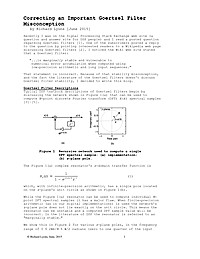
Correcting an Important Goertzel Filter Misconception
Summary
Rick Lyons' 2015 paper identifies and corrects a widespread misunderstanding about the Goertzel filter and its purported equivalence to a simple resonator. The paper explains the correct mathematical interpretation, demonstrates practical implications for single-bin DFT and tone-detection implementations, and offers guidance for accurate amplitude/phase estimation and robust embedded implementations.
Key Takeaways
- Recognize the correct mathematical relationship between the Goertzel algorithm and resonator filters, and why the common equivalence is misleading in many contexts.
- Apply the corrected formulas and interpretations to obtain unbiased amplitude and phase estimates from single-bin Goertzel outputs.
- Avoid common implementation pitfalls—such as improper scaling, omission of windowing, and numerical instability—that degrade Goertzel-based spectral estimates.
- Implement stable, efficient fixed-point or embedded Goertzel routines using the paper's recommended numerical precautions.
- Assess when to choose Goertzel versus FFT-based methods for single-tone detection (e.g., DTMF) based on accuracy, computational cost, and real-time constraints.
Who Should Read This
DSP engineers, embedded systems developers, and graduate students working on single-bin spectral analysis, tone detection, or communications receivers who need a correct understanding and robust implementations of the Goertzel algorithm.
TimelessAdvanced
Related Documents
- A New Approach to Linear Filtering and Prediction Problems TimelessAdvanced
- A Quadrature Signals Tutorial: Complex, But Not Complicated TimelessIntermediate
- An Introduction To Compressive Sampling TimelessIntermediate
- Lecture Notes on Elliptic Filter Design TimelessAdvanced
- Computing FFT Twiddle Factors TimelessAdvanced