An Interesting Fourier Transform - 1/f Noise
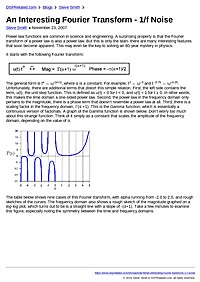
Power law functions are common in science and engineering. A surprising property is that the Fourier transform of a power law is also a power law. But this is only the start- there are many interesting features that soon become apparent. This may...

Summary
Steve Smith examines the surprising relationship between power-law (1/f) time-domain behavior and its Fourier transform, showing that power laws map to power laws in frequency under broad conditions. Readers will learn the mathematical basis for this result, practical consequences for power spectral density estimation, and common pitfalls when measuring and synthesizing 1/f noise.
Key Takeaways
- Explain the mathematical relationship that causes power-law (1/f) signals to produce power-law Fourier spectra.
- Derive the spectral slope relationship and state the conditions and limits where the power-law transform holds.
- Demonstrate practical implications for PSD estimation, log–log slope fitting, and bias in spectral analysis.
- Provide methods to synthesize 1/f noise and discuss common measurement pitfalls and how to avoid them.
Who Should Read This
Intermediate signal-processing engineers, researchers, or students working on noise modeling, spectral analysis, or system identification who want a deeper understanding of 1/f noise and its Fourier properties.
TimelessIntermediate
Related Documents
- A New Approach to Linear Filtering and Prediction Problems TimelessAdvanced
- A Quadrature Signals Tutorial: Complex, But Not Complicated TimelessIntermediate
- An Introduction To Compressive Sampling TimelessIntermediate
- Lecture Notes on Elliptic Filter Design TimelessAdvanced
- Computing FFT Twiddle Factors TimelessAdvanced