Spectral Flipping Around Signal Center Frequency
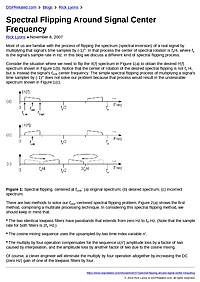
Most of us are familiar with the process of flipping the spectrum (spectral inversion) of a real signal by multiplying that signal's time samples by (-1)n. In that process the center of spectral rotation is fs/4, where fs is the signal's sample...
Summary
This blog explains the phenomenon of spectral flipping (spectral inversion) for discrete-time real signals and why the rotation center can be at frequencies other than fs/4. Readers will learn the math behind multiplying time samples by sign sequences and practical methods to rotate or translate spectra around an arbitrary center frequency for DSP applications.
Key Takeaways
- Explain why multiplying a real discrete-time signal by (-1)^n flips the spectrum about fs/4 and the underlying symmetry that causes this center.
- Demonstrate how to rotate or translate a spectrum around an arbitrary center frequency using time-domain multiplication and complex modulation.
- Compute the spectral mapping and identify aliasing or image issues that arise when performing spectral flipping in sampled systems.
- Apply spectral-flipping techniques to practical tasks such as image rejection, frequency translation, test-signal generation, and receiver front-end processing.
Who Should Read This
DSP engineers, researchers, and advanced students working in communications, radar, or audio/speech who need to manipulate or reason about sampled-signal spectra and frequency translation.
TimelessIntermediate
Related Documents
- A New Approach to Linear Filtering and Prediction Problems TimelessAdvanced
- A Quadrature Signals Tutorial: Complex, But Not Complicated TimelessIntermediate
- An Introduction To Compressive Sampling TimelessIntermediate
- Lecture Notes on Elliptic Filter Design TimelessAdvanced
- Computing FFT Twiddle Factors TimelessAdvanced