







Matlab Code to Synthesize Multiplierless FIR Filters
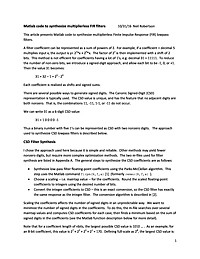
This article presents Matlab code to synthesize multiplierless Finite Impulse Response (FIR) lowpass filters. A filter coefficient can be represented as a sum of powers of 2. For example, if a coefficient = decimal 5 multiplies input x,...

Summary
This blog provides MATLAB code and a methodology for synthesizing multiplierless FIR lowpass filters by expressing coefficients as sums of powers of two and mapping them to shift-and-add structures. Readers will learn how to decompose coefficients (PO2/CSD-style), generate bit-true fixed-point implementations in MATLAB, and evaluate the trade-offs between coefficient sparsity, filter order, and frequency response for real-time or hardware deployment.
Key Takeaways
- Synthesize multiplierless FIR filters in MATLAB using coefficient decomposition into sums of powers of two (PO2) and related encodings.
- Represent and quantize coefficients with techniques such as PO2 and CSD to minimize nonzero adders.
- Convert decomposed coefficients into shift-and-add structures to eliminate hardware multipliers.
- Evaluate and trade off filter response degradation versus implementation complexity (adder count, shifts, filter order).
- Adapt and test the generated designs for fixed-point, bit-true simulation and target real-time hardware (DSP/FPGA).
Who Should Read This
DSP engineers, embedded/FPGA designers, and graduate students with experience in filter design who need practical methods to implement low-power, multiplierless FIR filters in MATLAB and for hardware deployment.
Still RelevantIntermediate
Related Documents
- Lecture Notes on Elliptic Filter Design TimelessAdvanced
- Computing FFT Twiddle Factors TimelessAdvanced
- Digital Envelope Detection: The Good, the Bad, and the Ugly TimelessIntermediate
- The World's Most Interesting FIR Filter Equation: Why FIR Filters Can Be Line... TimelessAdvanced
- A Beginner's Guide To Cascaded Integrator-Comb (CIC) Filters TimelessBeginner









