Some Thoughts on Sampling
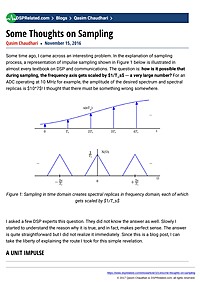
Some time ago, I came across an interesting problem. In the explanation of sampling process, a representation of impulse sampling shown in Figure 1 below is illustrated in almost every textbook on DSP and communications. The question is: how is...

Summary
This blog explores common textbook representations of impulse sampling and questions subtle but important assumptions in how sampling is drawn and interpreted. The author clarifies the mathematical model of impulse- and pulse-sampling, shows consequences for spectral replication and reconstruction, and connects theory to practical ADC models.
Key Takeaways
- Differentiate between ideal impulse sampling (Dirac comb) and practical pulse/hold sampling and the implications for amplitude scaling
- Derive how sampling produces spectral replicas and apply the Nyquist criterion to predict aliasing
- Calculate the correct scaling factors when representing continuous-time signals with impulse trains in analytical work
- Assess the impact of zero-order-hold and other practical front-end behaviors on reconstructed spectrum
- Design or select anti-aliasing and reconstruction filters based on the true sampling model used
Who Should Read This
DSP and communications engineers (intermediate level) who want a clearer, practical understanding of sampling models, aliasing, and reconstruction for analysis or ADC design.
TimelessIntermediate
Related Documents
- A New Approach to Linear Filtering and Prediction Problems TimelessAdvanced
- A Quadrature Signals Tutorial: Complex, But Not Complicated TimelessIntermediate
- An Introduction To Compressive Sampling TimelessIntermediate
- Lecture Notes on Elliptic Filter Design TimelessAdvanced
- Computing FFT Twiddle Factors TimelessAdvanced