The Risk In Using Frequency Domain Curves To Evaluate Digital Integrator Performance
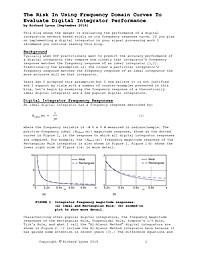
This article shows the danger in evaluating the performance of a digital integration network based solely on its frequency response curve. If you plan on implementing a digital integrator in your signal processing work I recommend you continue reading this article.
Summary
This article demonstrates why evaluating a digital integrator solely from its frequency‑domain curve can be misleading and potentially dangerous. Rick Lyons explains how time‑domain behavior, finite‑word‑length effects, and statistical considerations change real integrator performance and what tests engineers should run instead.
Key Takeaways
- Recognize that frequency‑response plots hide time‑domain effects such as drift, ramp error, and transient settling that dominate integrator behavior.
- Analyze integrator performance with time‑domain tests (step, ramp, long‑duration inputs) and statistical metrics in addition to FFT-based spectra.
- Simulate finite‑precision implementations to expose quantization noise, limit cycles, and state overflow that frequency curves do not show.
- Use complementary evaluations—transient response, stability margins, and noise accumulation—to validate integrator designs before deployment.
Who Should Read This
Advanced DSP, control, or systems engineers designing or validating digital integrators who need to ensure robust time‑domain and implementation behavior in real systems.
TimelessAdvanced
Related Documents
- A New Approach to Linear Filtering and Prediction Problems TimelessAdvanced
- A Quadrature Signals Tutorial: Complex, But Not Complicated TimelessIntermediate
- An Introduction To Compressive Sampling TimelessIntermediate
- Lecture Notes on Elliptic Filter Design TimelessAdvanced
- Computing FFT Twiddle Factors TimelessAdvanced