DSPRelated.com
Model Signal Impairments at Complex Baseband

Model Signal Impairments at Complex Baseband

Neil Robertson
Still RelevantIntermediate

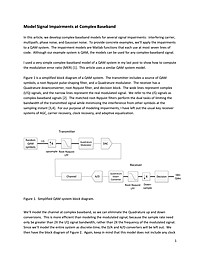
In this article, we develop complex-baseband models for several signal impairments: interfering carrier, multipath, phase noise, and Gaussian noise. To provide concrete examples, we'll apply the impairments to a QAM system. The impairment models are Matlab functions that each use at most seven lines of code. Although our example system is QAM, the models can be used for any complex-baseband signal.



Summary

Neil Robertson develops compact complex-baseband models for common signal impairments — interfering carrier, multipath, phase noise, and Gaussian noise — and demonstrates their application to a QAM system. Each impairment is implemented as a concise MATLAB function (no more than seven lines) and the models are directly usable with any complex-baseband signal.

Key Takeaways

  • Implement concise MATLAB functions (≤7 lines) that model interfering carrier, multipath, phase noise, and AWGN in complex baseband.
  • Apply impairment models to a QAM transmitter/receiver chain to observe constellation distortion and spectral effects.
  • Analyze impairment consequences using spectral analysis, constellation plots, and link metrics such as EVM and BER.
  • Adapt the provided models to other modulation formats and incorporate them into link-level simulations or testbeds.
  • Integrate these simple impairment blocks into larger MATLAB/Simulink workflows for rapid prototyping and validation.

Who Should Read This

Intermediate communications or DSP engineers and system designers who build or test link-level simulations and want compact MATLAB models of RF/baseband impairments.

Still RelevantIntermediate

Topics

CommunicationsMATLAB/SimulinkStatistical Signal ProcessingFFT/Spectral Analysis

Related Documents