







Design IIR Filters Using Cascaded Biquads
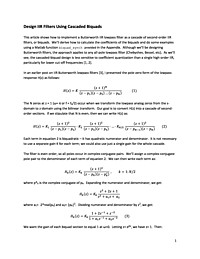
This article shows how to implement a Butterworth IIR lowpass filter as a cascade of second-order IIR filters, or biquads. We'll derive how to calculate the coefficients of the biquads and do some examples using a Matlab function biquad_synth provided in the Appendix. Although we'll be designing Butterworth filters, the approach applies to any all-pole lowpass filter (Chebyshev, Bessel, etc). As we'll see, the cascaded-biquad design is less sensitive to coefficient quantization than a single high-order IIR, particularly for lower cut-off frequencies.

Summary
This article shows how to synthesize Butterworth (and other all-pole) IIR lowpass filters by factoring a high-order prototype into a cascade of second-order sections (biquads). It derives the coefficient formulas, explains numerical/quantization advantages of the cascaded approach, and includes MATLAB examples and a biquad_synth function in the Appendix.
Key Takeaways
- Derive the mapping from continuous-time Butterworth poles to discrete-time biquad coefficients using the bilinear transform and pole pairing rules.
- Compute and assemble cascaded second-order sections to implement a stable high-order IIR lowpass filter with reduced sensitivity to coefficient quantization.
- Implement the provided MATLAB biquad_synth routine to synthesize, test, and visualize amplitude and pole-zero responses of the cascaded filter.
- Assess numerical stability and quantization effects of cascaded biquads versus single high-order IIR realizations and choose appropriate section ordering and scaling.
Who Should Read This
Intermediate DSP engineers or graduate students implementing digital IIR filters who need practical methods to design robust lowpass filters and reduce coefficient-quantization sensitivity.
TimelessIntermediate
Related Documents
- A Quadrature Signals Tutorial: Complex, But Not Complicated TimelessIntermediate
- Lecture Notes on Elliptic Filter Design TimelessAdvanced
- Computing FFT Twiddle Factors TimelessAdvanced
- Digital Envelope Detection: The Good, the Bad, and the Ugly TimelessIntermediate
- The World's Most Interesting FIR Filter Equation: Why FIR Filters Can Be Line... TimelessAdvanced









