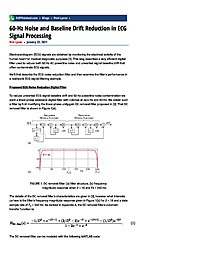
60-Hz Noise and Baseline Drift Reduction in ECG Signal Processing
Electrocardiogram (ECG) signals are obtained by monitoring the electrical activity of the human heart for medical diagnostic purposes [1]. This blog describes a very efficient digital filter used to reduce both 60 Hz AC powerline noise and...
Summary
This blog presents a compact, efficient digital filtering approach to remove 60 Hz powerline interference and baseline wander from ECG recordings. The author explains filter structures, design trade-offs, and implementation tips that help engineers achieve low-distortion, real-time ECG preprocessing.
Key Takeaways
- Design a narrow, high-Q notch (or equivalent IIR/FIR) to suppress 60 Hz mains while preserving ECG morphology
- Combine notch filtering with a low-cut (high-pass) stage or baseline-wander removal to eliminate slow drift
- Implement zero-phase or bidirectional filtering strategies to avoid waveform distortion when needed
- Use FFT/Spectral Analysis to identify residual harmonics and validate filter performance on real ECG traces
- Optimize filter coefficients and use fixed-point considerations for real-time embedded deployment
Who Should Read This
Intermediate DSP engineers, biomedical signal analysts, and embedded developers who need practical, low-cost methods to remove mains interference and baseline drift from ECG signals.
Still RelevantIntermediate
Related Documents
- A Quadrature Signals Tutorial: Complex, But Not Complicated TimelessIntermediate
- Lecture Notes on Elliptic Filter Design TimelessAdvanced
- Computing FFT Twiddle Factors TimelessAdvanced
- Digital Envelope Detection: The Good, the Bad, and the Ugly TimelessIntermediate
- The World's Most Interesting FIR Filter Equation: Why FIR Filters Can Be Line... TimelessAdvanced