







An Efficient Full-Band Sliding DFT Spectrum Analyzer
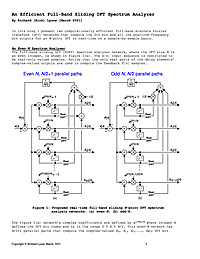
In this blog I present two computationally efficient full-band discrete Fourier transform (DFT) networks that compute the 0th bin and all the positive-frequency bin outputs for an N-point DFT in real-time on a sample-by-sample basis. An Even-N...
Summary
This blog presents two computationally efficient full-band sliding DFT network architectures that compute the 0th bin and all positive-frequency bin outputs for an N-point DFT on a sample-by-sample basis. Readers will learn the Even-N and Odd-N design variants, their arithmetic and memory advantages, and how to apply the architectures for real-time spectral monitoring with stable, low-cost implementations.
Key Takeaways
- Implement a sample-by-sample full-band sliding DFT that yields all positive-frequency bins with constant per-sample cost.
- Compare Even-N and Odd-N network architectures and select the variant that balances complexity, latency, and numerical stability for a given N.
- Optimize arithmetic (complex vs. real operations) and memory to meet real-time constraints on embedded DSP processors.
- Apply filter-based interpretations and windowing strategies to control leakage and improve spectral estimates in continuous monitoring applications.
Who Should Read This
DSP engineers and algorithm developers (intermediate to advanced) building real-time spectral analyzers or low-latency receivers for audio, communications, or radar systems.
Still RelevantAdvanced
Related Documents
- A Quadrature Signals Tutorial: Complex, But Not Complicated TimelessIntermediate
- Lecture Notes on Elliptic Filter Design TimelessAdvanced
- Computing FFT Twiddle Factors TimelessAdvanced
- Digital Envelope Detection: The Good, the Bad, and the Ugly TimelessIntermediate
- The World's Most Interesting FIR Filter Equation: Why FIR Filters Can Be Line... TimelessAdvanced










