







DSPRelated.com
Multiplierless Exponential Averaging

Multiplierless Exponential Averaging

Rick Lyons
Still RelevantIntermediate

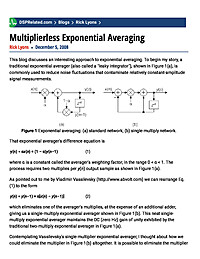
This blog discusses an interesting approach to exponential averaging. To begin my story, a traditional exponential averager (also called a "leaky integrator"), shown in Figure 1(a), is commonly used to reduce noise fluctuations that contaminate...


Summary

This blog explains a multiplierless approach to exponential averaging (leaky integrators), showing how to implement smoothing filters without multipliers using shift-and-add and power-of-two coefficient approximations. Readers will learn practical trade-offs in time constant approximation, noise smoothing, and resource-efficient implementation for embedded or FPGA-based DSP systems.

Key Takeaways

  • Implement a multiplierless exponential averager using power-of-two coefficient approximations and shift-add operations.
  • Design and tune equivalent time constants and pole locations when replacing exact coefficients with multiplier-free approximations.
  • Analyze the impact of coefficient quantization and fixed-point arithmetic on noise reduction and transient response.
  • Optimize resource usage for embedded DSP, FPGA, or ASIC targets by minimizing multiplies and evaluating latency/cost trade-offs.
  • Integrate multiplierless averaging into applications (spectral smoothing, control loops, envelope detection) while preserving stability and performance.

Who Should Read This

Intermediate DSP engineers, embedded systems and FPGA/ASIC designers who need low-cost, multiplier-free smoothing filters for real-time estimation, spectral smoothing, or control tasks.

Still RelevantIntermediate

Topics

Filter DesignAdaptive FilteringStatistical Signal ProcessingReal-Time DSP

Related Documents








