







DSPRelated.com
Determination of the transfer function of passive networks with MATLAB Functions

Determination of the transfer function of passive networks with MATLAB Functions

Josef Hoffmann
Still RelevantIntermediate

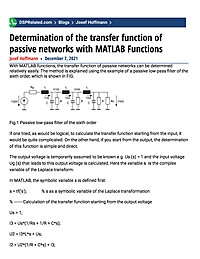
With MATLAB functions, the transfer function of passive networks can be determined relatively easily. The method is explained using the example of a passive low-pass filter of the sixth order, which is shown in FIG.Fig.1 Passive low-pass filter...



Summary

This blog shows how to determine the transfer function of passive networks using MATLAB functions, demonstrated on a sixth-order passive low-pass filter. Readers will learn how to form circuit equations, compute the transfer function numerically, and visualize frequency response and pole-zero structure in MATLAB.

Key Takeaways

  • Compute a passive network's transfer function directly from component values using MATLAB scripts and built-in linear algebra functions.
  • Derive and assemble nodal/mesh system matrices for RLC networks to form the transfer function.
  • Plot and analyze frequency response (Bode/magnitude/phase) and extract poles and zeros for a sixth-order low-pass example.
  • Validate the derived transfer function through time- and frequency-domain checks and compare with analytical expectations.

Who Should Read This

Electrical engineers, DSP practitioners, and advanced students with basic circuit and MATLAB experience who need a practical method to extract and analyze transfer functions of passive filters.

Still RelevantIntermediate

Topics

Filter DesignMATLAB/SimulinkFFT/Spectral Analysis

Related Documents





