Summary
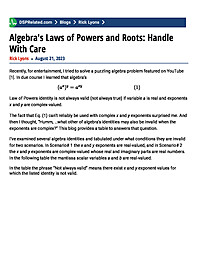
Rick Lyons' blog explains why common algebraic rules for powers and roots can mislead engineers working with complex-valued signals. The post shows how principal branches, sign conventions, and implicit assumptions affect FFTs, filter algebra, and other DSP workflows, and gives pragmatic guidance to avoid subtle bugs.
Key Takeaways
- Recognize when exponentiation and root identities break for complex numbers and non-integer exponents, and where branch cuts matter.
- Use explicit principal-value conventions or branch-aware library routines when computing complex powers or roots.
- Avoid algebraic shortcuts when manipulating phasors, spectra, or pole/zero expressions—preserve phase and sign information.
- Validate analytic manipulations with numeric tests and representative signals to catch phase-wrap and sign errors early.
Who Should Read This
Practicing DSP engineers, algorithm developers, and advanced students who implement FFTs, filter designs, or complex-domain signal processing and want to avoid subtle algebraic and numerical pitfalls.
TimelessAdvanced
Related Documents
- A New Approach to Linear Filtering and Prediction Problems TimelessAdvanced
- A Quadrature Signals Tutorial: Complex, But Not Complicated TimelessIntermediate
- An Introduction To Compressive Sampling TimelessIntermediate
- Lecture Notes on Elliptic Filter Design TimelessAdvanced
- Computing FFT Twiddle Factors TimelessAdvanced