Cascaded Integrator-Comb (CIC) Filter Introduction
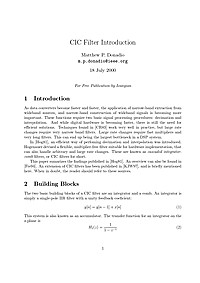
In the classic paper, "An Economical Class of Digital Filters for Decimation and Interpolation", Hogenauer introduced an important class of digital filters called "Cascaded Integrator-Comb", or "CIC" for short (also sometimes called "Hogenauer filters"). Here, Matthew Donadio provides a more gentle introduction to the subject of CIC filters, geared specifically to the needs of practicing DSP designers.

Summary
Matthew Donadio presents a practical, accessible introduction to Cascaded Integrator-Comb (CIC) filters, explaining their structure, operation, and role in efficient decimation and interpolation. The article emphasizes design trade-offs, implementation considerations for hardware and fixed-point systems, and simple compensation strategies for passband droop and aliasing control.
Key Takeaways
- Describe the basic CIC architecture (integrator and comb stages) and derive its frequency response.
- Choose decimation/interpolation factors and number of stages to meet aliasing and stopband requirements.
- Quantify and compensate passband droop using simple FIR compensation filters or cascade strategies.
- Implement CIC filters efficiently in fixed-point and hardware (minimal multipliers and memory) and manage internal word growth.
- Analyze trade-offs between hardware cost, filter complexity, and spectral performance for multirate DSP systems.
Who Should Read This
Practicing DSP engineers and system designers with some DSP background who need a practical, implementation-focused introduction to CIC filters for decimation and interpolation.
TimelessIntermediate
Related Documents
- Lecture Notes on Elliptic Filter Design TimelessAdvanced
- Computing FFT Twiddle Factors TimelessAdvanced
- Digital Envelope Detection: The Good, the Bad, and the Ugly TimelessIntermediate
- The World's Most Interesting FIR Filter Equation: Why FIR Filters Can Be Line... TimelessAdvanced
- A Beginner's Guide To Cascaded Integrator-Comb (CIC) Filters TimelessBeginner