







Finding the Eigenstructure of A
Starting with the defining equation for an eigenvector
 and its
corresponding eigenvalue
and its
corresponding eigenvalue  ,
,

![$\displaystyle \left[\begin{array}{cc} c & c-1 \\ [2pt] c+1 & c \end{array}\righ...
...egin{array}{c} \lambda_i \\ [2pt] \lambda_i \eta_i \end{array}\right]. \protect$](http://www.dsprelated.com/josimages_new/filters/img2255.png)
We normalized the first element of
 to 1 since
 is an
eigenvector whenever
is. (If there is a missing solution
because its first element happens to be zero, we can repeat the
analysis normalizing the second element to 1 instead.)
is an
eigenvector whenever
is. (If there is a missing solution
because its first element happens to be zero, we can repeat the
analysis normalizing the second element to 1 instead.)
Equation (G.23) gives us two equations in two unknowns:


Substituting the first into the second to eliminate
 , we get
![\begin{eqnarray*}
1+c+c\eta_i &=& [c+\eta_i (c-1)]\eta_i = c\eta_i + \eta_i ^2 (...
...-1)\\
\,\,\Rightarrow\,\,\eta_i &=& \pm \sqrt{\frac{c+1}{c-1}}.
\end{eqnarray*}](http://www.dsprelated.com/josimages_new/filters/img2261.png)
Thus, we have found both eigenvectors
![\begin{eqnarray*}
\underline{e}_1&=&\left[\begin{array}{c} 1 \\ [2pt] \eta \end{...
...ght], \quad \hbox{where}\\
\eta&\isdef &\sqrt{\frac{c+1}{c-1}}.
\end{eqnarray*}](http://www.dsprelated.com/josimages_new/filters/img2262.png)
They are linearly independent provided
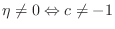 and finite provided
  .
.
We can now use Eq. (G.24) to find the eigenvalues:

 , the eigenvalues are
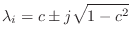
and so this is the range of
 corresponding to sinusoidal
oscillation. For
corresponding to sinusoidal
oscillation. For
 , the eigenvalues are real, corresponding
to exponential growth and decay. The values
, the eigenvalues are real, corresponding
to exponential growth and decay. The values  yield a repeated
root (dc or
yield a repeated
root (dc or  oscillation).
Let us henceforth assume
 . In this range
 is real, and we have
 ,
,
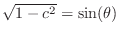 . Thus, the eigenvalues can be expressed as follows:

Equating to
 , we obtain
 , or
, or
 , where
  denotes the sampling rate. Thus the
relationship between the coefficient in the digital waveguide
oscillator and the frequency of sinusoidal oscillation
denotes the sampling rate. Thus the
relationship between the coefficient in the digital waveguide
oscillator and the frequency of sinusoidal oscillation  is
expressed succinctly as
is
expressed succinctly as
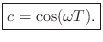
 , and that's the complete set of available
digital frequencies.
, and that's the complete set of available
digital frequencies.
We have now shown that the system of Fig.G.3 oscillates
sinusoidally at any desired digital frequency rad/sec by simply
setting
 , where
  denotes the sampling interval.
Next Section:
Choice of Output Signal and Initial Conditions
Previous Section:
Jordan Canonical Form












