State-Space Analysis Example:
The Digital Waveguide Oscillator
As an example of state-space analysis, we will use it to determine the frequency of oscillation of the system of Fig.G.3 [90].
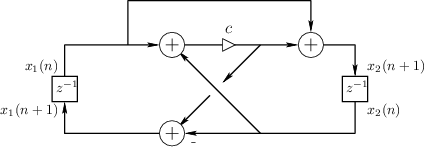
Note the assignments of unit-delay outputs to state variables  and
and  .
From the diagram, we see that
.
From the diagram, we see that
![$\displaystyle x_1(n+1) = c[x_1(n) + x_2(n)] - x_2(n) = c\,x_1(n) + (c-1) x_2(n)
$](http://www.dsprelated.com/josimages_new/filters/img2238.png)
![$\displaystyle x_2(n+1) = x_1(n) + c[x_1(n) + x_2(n)] = (1+c) x_1(n) + c\,x_2(n)
$](http://www.dsprelated.com/josimages_new/filters/img2239.png)
![$\displaystyle \left[\begin{array}{c} x_1(n+1) \\ [2pt] x_2(n+1) \end{array}\rig...
...ay}\right]}_A \left[\begin{array}{c} x_1(n) \\ [2pt] x_2(n) \end{array}\right]
$](http://www.dsprelated.com/josimages_new/filters/img2240.png)
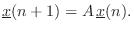 and :
and :
![\begin{eqnarray*}
y_1(n) &\isdef & x_1(n) = [1, 0] {\underline{x}}(n)\\
y_2(n) &\isdef & x_2(n) = [0, 1] {\underline{x}}(n)
\end{eqnarray*}](http://www.dsprelated.com/josimages_new/filters/img2242.png)
A basic fact from linear algebra is that the determinant of a
matrix is equal to the product of its eigenvalues. As a quick
check, we find that the determinant of  is
is

 .
.
Note that
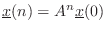 . If we diagonalize this system to
obtain
. If we diagonalize this system to
obtain
 , where
 diag
diag![$ [\lambda_1,\lambda_2]$](http://www.dsprelated.com/josimages_new/filters/img2247.png) ,
and
,
and  is the matrix of eigenvectors of ,
then we have
is the matrix of eigenvectors of ,
then we have
![$\displaystyle \underline{{\tilde x}}(n) = \tilde{A}^n\,\underline{{\tilde x}}(0...
...t[\begin{array}{c} {\tilde x}_1(0) \\ [2pt] {\tilde x}_2(0) \end{array}\right]
$](http://www.dsprelated.com/josimages_new/filters/img2248.png)
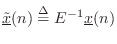 denotes the state vector in these
new ``modal coordinates''. Since
denotes the state vector in these
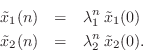
new ``modal coordinates''. Since  is diagonal, the modes are
decoupled, and we can write
is diagonal, the modes are
decoupled, and we can write
If this system is to generate a real sampled sinusoid at radian frequency
 , the eigenvalues
  and
and  must be of the form
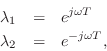
(in either order) where is real, and  denotes the sampling
interval in seconds.
denotes the sampling
interval in seconds.
Thus, we can determine the frequency of oscillation (and
verify that the system actually oscillates) by determining the
eigenvalues  of . Note that, as a prerequisite, it will
also be necessary to find two linearly independent eigenvectors of
(columns of ).
of . Note that, as a prerequisite, it will
also be necessary to find two linearly independent eigenvectors of
(columns of ).
Finding the Eigenstructure of A
Starting with the defining equation for an eigenvector
 and its
corresponding eigenvalue
and its
corresponding eigenvalue  ,
,

![$\displaystyle \left[\begin{array}{cc} c & c-1 \\ [2pt] c+1 & c \end{array}\righ...
...egin{array}{c} \lambda_i \\ [2pt] \lambda_i \eta_i \end{array}\right]. \protect$](http://www.dsprelated.com/josimages_new/filters/img2255.png)
We normalized the first element of
 to 1 since
 is an
eigenvector whenever
is. (If there is a missing solution
because its first element happens to be zero, we can repeat the
analysis normalizing the second element to 1 instead.)
is an
eigenvector whenever
is. (If there is a missing solution
because its first element happens to be zero, we can repeat the
analysis normalizing the second element to 1 instead.)
Equation (G.23) gives us two equations in two unknowns:


Substituting the first into the second to eliminate
, we get
![\begin{eqnarray*}
1+c+c\eta_i &=& [c+\eta_i (c-1)]\eta_i = c\eta_i + \eta_i ^2 (...
...-1)\\
\,\,\Rightarrow\,\,\eta_i &=& \pm \sqrt{\frac{c+1}{c-1}}.
\end{eqnarray*}](http://www.dsprelated.com/josimages_new/filters/img2261.png)
Thus, we have found both eigenvectors
![\begin{eqnarray*}
\underline{e}_1&=&\left[\begin{array}{c} 1 \\ [2pt] \eta \end{...
...ght], \quad \hbox{where}\\
\eta&\isdef &\sqrt{\frac{c+1}{c-1}}.
\end{eqnarray*}](http://www.dsprelated.com/josimages_new/filters/img2262.png)
They are linearly independent provided
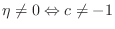 and finite provided
  .
.
We can now use Eq. (G.24) to find the eigenvalues:

 , the eigenvalues are
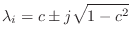
and so this is the range of
 corresponding to sinusoidal
oscillation. For
corresponding to sinusoidal
oscillation. For
 , the eigenvalues are real, corresponding
to exponential growth and decay. The values
, the eigenvalues are real, corresponding
to exponential growth and decay. The values  yield a repeated
root (dc or
yield a repeated
root (dc or  oscillation).
Let us henceforth assume
 . In this range
 is real, and we have
 ,
,
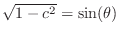 . Thus, the eigenvalues can be expressed as follows:

Equating to
 , we obtain
 , or
, or
 , where
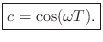
  denotes the sampling rate. Thus the
relationship between the coefficient in the digital waveguide
oscillator and the frequency of sinusoidal oscillation is
expressed succinctly as
denotes the sampling rate. Thus the
relationship between the coefficient in the digital waveguide
oscillator and the frequency of sinusoidal oscillation is
expressed succinctly as
 , and that's the complete set of available
digital frequencies.
, and that's the complete set of available
digital frequencies.
We have now shown that the system of Fig.G.3 oscillates
sinusoidally at any desired digital frequency rad/sec by simply
setting
 , where denotes the sampling interval.
Choice of Output Signal and Initial Conditions
Recalling that
 , the output signal from any diagonal
state-space model is a linear combination of the modal signals. The
two immediate outputs and in Fig.G.3 are given
in terms of the modal signals
, the output signal from any diagonal
state-space model is a linear combination of the modal signals. The
two immediate outputs and in Fig.G.3 are given
in terms of the modal signals
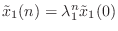 and
and
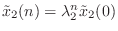 as
as
![\begin{eqnarray*}
y_1(n) &=& [1, 0] {\underline{x}}(n) = [1, 0] \left[\begin{arr...
...\lambda_1^n {\tilde x}_1(0) - \eta \lambda_2^n\,{\tilde x}_2(0).
\end{eqnarray*}](http://www.dsprelated.com/josimages_new/filters/img2283.png)
The output signal from the first state variable is

The initial condition
![$ {\underline{x}}(0) = [1, 0]^T$](http://www.dsprelated.com/josimages_new/filters/img2285.png) corresponds to modal initial
state
corresponds to modal initial
state
![$\displaystyle \underline{{\tilde x}}(0) = E^{-1}\left[\begin{array}{c} 1 \\ [2p...
...nd{array}\right] = \left[\begin{array}{c} 1/2 \\ [2pt] 1/2 \end{array}\right].
$](http://www.dsprelated.com/josimages_new/filters/img2286.png)
 from the first state
variable
from the first state
variable  is simply
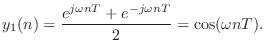
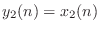 is proportional to
 , i.e., it is
in phase quadrature with respect to
, i.e., it is
in phase quadrature with respect to
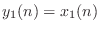 ).
Phase-quadrature outputs are often useful in practice, e.g., for
generating complex sinusoids.
).
Phase-quadrature outputs are often useful in practice, e.g., for
generating complex sinusoids.
Next Section:
References
Previous Section:
Repeated Poles