PFE to Real, Second-Order Sections
When all coefficients of  and
and  are real (implying that
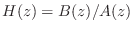 is the transfer function of
a real filter), it will
always happen that the complex one-pole filters will occur in
complex conjugate pairs. Let
is the transfer function of
a real filter), it will
always happen that the complex one-pole filters will occur in
complex conjugate pairs. Let  denote any one-pole
section in the PFE of Eq.
denote any one-pole
section in the PFE of Eq. (6.7). Then if
  is complex and
  describes a real filter, we will also find
 somewhere among
the terms in the one-pole expansion. These two terms can be paired to
form a real second-order section as follows:
somewhere among
the terms in the one-pole expansion. These two terms can be paired to
form a real second-order section as follows:
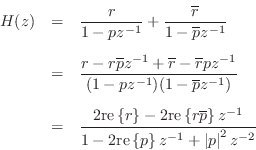
Expressing the pole in polar form as
 ,
and the residue as
,
and the residue as
 ,
the last expression above can be rewritten as
,
the last expression above can be rewritten as

Expanding a transfer function into a sum of second-order terms with
real coefficients gives us the filter coefficients for a parallel bank
of real second-order filter sections. (Of course, each real pole can
be implemented in its own real one-pole section in parallel with the
other sections.) In view of the foregoing, we may conclude that every
real filter with  can be implemented as a parallel bank
of biquads.7.6 However, the full generality of a biquad
section (two poles and two zeros) is not needed because the PFE
requires only one zero per second-order term.
can be implemented as a parallel bank
of biquads.7.6 However, the full generality of a biquad
section (two poles and two zeros) is not needed because the PFE
requires only one zero per second-order term.
To see why we must stipulate in Eq.(6.7), consider the sum of two
first-order terms by direct calculation:
 |
(7.9) |
Notice that the numerator order, viewed as a polynomial in
 , is
one less than the denominator order. In the same way, it is easily
shown by mathematical induction that the sum of
, is
one less than the denominator order. In the same way, it is easily
shown by mathematical induction that the sum of  one-pole terms
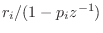 can produce a numerator order of at most
  (while the denominator order is if there are no pole-zero
cancellations). Following terminology used for analog filters, we
call the case a strictly proper transfer
function.7.7 Thus, every strictly
proper transfer function (with distinct poles) can be implemented
using a parallel bank of two-pole, one-zero filter sections.
(while the denominator order is if there are no pole-zero
cancellations). Following terminology used for analog filters, we
call the case a strictly proper transfer
function.7.7 Thus, every strictly
proper transfer function (with distinct poles) can be implemented
using a parallel bank of two-pole, one-zero filter sections.
Next Section:
Inverting the Z Transform
Previous Section:
Complex Example