







State Space Realization
Above, we used a matrix multiply to represent convolution of the
filter input signal with the filter's impulse response. This only
works for FIR filters since an IIR filter would require an infinite
impulse-response matrix. IIR filters have an extensively used matrix
representation called state space form
(or ``state space realizations'').
They are especially convenient for representing filters with
multiple inputs and multiple outputs (MIMO filters).
An order  digital filter with
  inputs and
  outputs can be written
in state-space form as follows:
outputs can be written
in state-space form as follows:


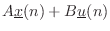

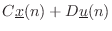
where
 is the length state vector at discrete time
 ,
,
 is a
is a  vector of inputs, and
 the
the
 output vector.
  is the
  state
transition matrix, and it determines the dynamics of the
system (its poles, or resonant modes).
state
transition matrix, and it determines the dynamics of the
system (its poles, or resonant modes).
State-space models are described further in Appendix G. Here, we will only give an illustrative example and make a few observations:
State Space Filter Realization Example
The digital filter having difference equation

![$\displaystyle \left[\begin{array}{c} x_1(n+1) \\ [2pt] x_2(n+1) \\ [2pt] x_3(n+1)\end{array}\right]$](http://www.dsprelated.com/josimages_new/filters/img2015.png)
![$\displaystyle \left[\begin{array}{ccc}
0 & 1 & 0\\ [2pt]
0 & 0 & 1\\ [2pt]
0.01...
...\right] +
\left[\begin{array}{c} 0 \\ [2pt] 0 \\ [2pt] 1\end{array}\right] u(n)$](http://www.dsprelated.com/josimages_new/filters/img2016.png)
![$\displaystyle \left[\begin{array}{ccc} 0 & 1 & 1\end{array}\right]
\left[\begin{array}{c} x_1(n) \\ [2pt] x_2(n) \\ [2pt] x_3(n)\end{array}\right]
\protect$](http://www.dsprelated.com/josimages_new/filters/img2017.png)
Thus,
![$ {\underline{x}}(n) = [x_1(n), x_2(n), x_3(n)]^T$](http://www.dsprelated.com/josimages_new/filters/img2018.png) is the vector of state
variables at time ,
is the vector of state
variables at time ,
![$ B = [0,0,1]^T$](http://www.dsprelated.com/josimages_new/filters/img2019.png) is the state-input gain vector,
is the state-input gain vector,
![$ C = [0,1,1]$](http://www.dsprelated.com/josimages_new/filters/img2020.png) is the vector of state-gains for the output, and the
direct-path gain is
is the vector of state-gains for the output, and the
direct-path gain is  .
.
This example is repeated using matlab in §G.7.8 (after we have covered transfer functions).
A general procedure for converting any difference equation to
state-space form is described in §G.7. The particular
state-space model shown in Eq. (F.5) happens to be called
controller canonical form,
for reasons discussed in Appendix G.
The set of all state-space realizations of this filter is given by
exploring the set of all similarity transformations applied to
any particular realization, such as the control-canonical form in
Eq.(F.5). Similarity transformations are discussed in
§G.8, and in books on linear algebra [58].
(F.5) happens to be called
controller canonical form,
for reasons discussed in Appendix G.
The set of all state-space realizations of this filter is given by
exploring the set of all similarity transformations applied to
any particular realization, such as the control-canonical form in
Eq.(F.5). Similarity transformations are discussed in
§G.8, and in books on linear algebra [58].
Note that the state-space model replaces an th-order
difference equation by a vector first-order difference
equation. This provides elegant simplifications in the theory and
analysis of digital filters. For example, consider the case  ,
and , so that Eq.(F.4) reduces to
,
and , so that Eq.(F.4) reduces to

where
is the transition matrix, and both
and
are  signal vectors. (This filter has inputs
and outputs.) This vector first-order difference equation is
analogous to the following scalar first-order difference equation:
signal vectors. (This filter has inputs
and outputs.) This vector first-order difference equation is
analogous to the following scalar first-order difference equation:

 is given by

 .) Similarly, setting
 to in Eq.(F.6)
yields
to in Eq.(F.6)
yields
 th-order digital filter ``looks like'' a first-order
digital filter when cast in state-space form.
th-order digital filter ``looks like'' a first-order
digital filter when cast in state-space form.
Next Section:
Time Domain Filter Estimation
Previous Section:
Inverse Filters












