







Two-Pole Partial Fraction Expansion
Note that every real two-pole resonator can be broken up into a sum of two complex one-pole resonators:

where
 and
and  are constants (generally complex). In this
``parallel one-pole'' form, it can be seen that the peak gain is no
longer equal to the resonance gain, since each one-pole frequency
response is ``tilted'' near resonance by being summed with the
``skirt'' of the other one-pole resonator, as illustrated in
Fig.B.9. This interaction between the positive- and negative-frequency
poles is minimized by making the resonance sharper (
are constants (generally complex). In this
``parallel one-pole'' form, it can be seen that the peak gain is no
longer equal to the resonance gain, since each one-pole frequency
response is ``tilted'' near resonance by being summed with the
``skirt'' of the other one-pole resonator, as illustrated in
Fig.B.9. This interaction between the positive- and negative-frequency
poles is minimized by making the resonance sharper (
 ),
and by separating the pole frequencies
),
and by separating the pole frequencies
 . The
greatest separation occurs when the resonance frequency is at
one-fourth the sampling rate (
. The
greatest separation occurs when the resonance frequency is at
one-fourth the sampling rate (
 ). However,
low-frequency resonances, which are by far the most common in audio
work, suffer from significant overlapping of the positive- and
negative-frequency poles.
). However,
low-frequency resonances, which are by far the most common in audio
work, suffer from significant overlapping of the positive- and
negative-frequency poles.
![\includegraphics[width=\twidth ]{eps/tppfe}](http://www.dsprelated.com/josimages_new/filters/img1419.png) |
 ,
, and
and
 , overlaid with the
frequency responses (dashed lines) of its positive- and
negative-frequency complex one-pole components. Also marked (dashed
lines) are the two resonance frequencies; the peak frequencies can be
seen to lie slightly outside the resonance frequencies.
, overlaid with the
frequency responses (dashed lines) of its positive- and
negative-frequency complex one-pole components. Also marked (dashed
lines) are the two resonance frequencies; the peak frequencies can be
seen to lie slightly outside the resonance frequencies.
To show Eq. (B.7) is always true, let's solve in general for
and given
(B.7) is always true, let's solve in general for
and given  and
and  . Recombining the right-hand side
over a common denominator and equating numerators gives
. Recombining the right-hand side
over a common denominator and equating numerators gives

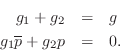
The solution is easily found to be
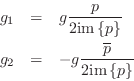
where we have assumed
im , as necessary to have a
resonator in the first place.
, as necessary to have a
resonator in the first place.
Breaking up the two-pole real resonator into a parallel sum of two complex one-pole resonators is a simple example of a partial fraction expansion (PFE) (discussed more fully in §6.8).
Note that the inverse z transform of a sum of one-pole transfer
functions can be easily written down by inspection. In particular,
the impulse response of the PFE of the two-pole resonator (see
Eq.(B.7)) is clearly

 is real, we must have
 , as we found above
without assuming it. If
, as we found above
without assuming it. If
 , then is a real sinusoid
created by the sum of two complex sinusoids spinning in opposite
directions on the unit circle.
, then is a real sinusoid
created by the sum of two complex sinusoids spinning in opposite
directions on the unit circle.
Next Section:
Exercise
Previous Section:
Resonator Bandwidth in Terms of Pole Radius












