







A Class of Well Posed Damped PDEs
A large class of well posed PDEs is given by [45]
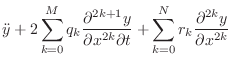
Thus, to the ideal string wave equation Eq.
 (C.1) we may add any
number of even-order partial derivatives in
(C.1) we may add any
number of even-order partial derivatives in  , plus any number of
mixed odd-order partial derivatives in and
, plus any number of
mixed odd-order partial derivatives in and  , where
differentiation with respect to occurs only once. Because every
member of this class of PDEs is only second-order in time, it is
guaranteed to be well posed, as we now show.
, where
differentiation with respect to occurs only once. Because every
member of this class of PDEs is only second-order in time, it is
guaranteed to be well posed, as we now show.
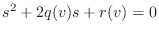
To show Eq.(D.5) is well posed [45], we must
show that the roots of the characteristic polynomial equation
(§D.3) have negative real parts, i.e., that they correspond to
decaying exponentials instead of growing exponentials. To do this, we
may insert the general eigensolution

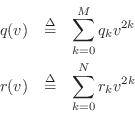
Let's now set  , where
 is radian spatial
frequency (called the ``wavenumber'' in acoustics) and of course
is radian spatial
frequency (called the ``wavenumber'' in acoustics) and of course
 , thereby converting the implicit spatial Laplace
transform to a spatial Fourier transform. Since there are only even
powers of the spatial Laplace transform variable
, thereby converting the implicit spatial Laplace
transform to a spatial Fourier transform. Since there are only even
powers of the spatial Laplace transform variable  , the polynomials
 and
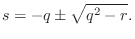
and  are real. Therefore, the roots of the
characteristic polynomial equation (the natural frequencies of the
time response of the system), are given by
are real. Therefore, the roots of the
characteristic polynomial equation (the natural frequencies of the
time response of the system), are given by
Next Section:
Proof that the Third-Order Time Derivative is Ill Posed
Previous Section:
Poles at











