Converting Any String State to Traveling Slope-Wave Components
We verified in §C.3.1 above that traveling-wave components  and
and  in Eq.
 (C.14) satisfy the ideal string wave equation
 . By definition, the physical string displacement is
given by the sum of the traveling-wave components, or
. By definition, the physical string displacement is
given by the sum of the traveling-wave components, or

Thus, given any pair of traveling waves
and , we can
compute a corresponding string displacement  . This leads to the
question whether any initial string state can be converted to a pair
of equivalent traveling-wave components. If so, then d'Alembert's
traveling-wave solution is complete, and all solutions to the
ideal string wave equation can be expressed in terms of traveling waves.
. This leads to the
question whether any initial string state can be converted to a pair
of equivalent traveling-wave components. If so, then d'Alembert's
traveling-wave solution is complete, and all solutions to the
ideal string wave equation can be expressed in terms of traveling waves.
The state of an ideal string at
time  is classically specified by its displacement
  and
velocity
and
velocity

 [317]. Equation (C.15) gives us as a simple sum of
the traveling-wave components, and now we need a formula for
[317]. Equation (C.15) gives us as a simple sum of
the traveling-wave components, and now we need a formula for  in
terms of them as well. It will be derived in §C.7.3
(see Equations (C.44-C.46)) that we can write
in
terms of them as well. It will be derived in §C.7.3
(see Equations (C.44-C.46)) that we can write

 denotes the partial derivative with respect to as
usual. We have
denotes the partial derivative with respect to as
usual. We have
![$\displaystyle \left[\begin{array}{c} y(t,x) \\ [2pt] v(t,x) \end{array}\right] ...
...ght]
\left[\begin{array}{c} y_r(t-x/c) \\ [2pt] y_l(t+x/c) \end{array}\right].
$](http://www.dsprelated.com/josimages_new/pasp/img3273.png)
![$\displaystyle \left[\begin{array}{c} y'^{+} \\ [2pt] y'^{-} \end{array}\right] ...
...eft[\begin{array}{c} y'-\frac{v}{c} \\ [2pt] y'+\frac{v}{c} \end{array}\right]
$](http://www.dsprelated.com/josimages_new/pasp/img3274.png) , and choosing the constant
of integration to give the correct constant component of , we
obtain the displacement-wave components
, and choosing the constant
of integration to give the correct constant component of , we
obtain the displacement-wave components
![$\displaystyle \left[\begin{array}{c} y^{+} \\ [2pt] y^{-} \end{array}\right] \eqsp \frac{1}{2}\left[\begin{array}{c} y-w \\ [2pt] y+w \end{array}\right]
$](http://www.dsprelated.com/josimages_new/pasp/img3275.png)
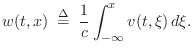
It will be seen in §C.7.4 that state conversion between physical variables and traveling-wave components is simpler when force and velocity are chosen as the physical state variables (as opposed to displacement and velocity used here).
Next Section:
Digital Waveguide Model
Previous Section:
D'Alembert Derived