Sign in

username:

password:


Not a member?

Search Online Books


Search tips

Free Online Books

Sponsor

NEW! TMS320C6474: 3x the performance. 1/3 the cost. Three 1 GHz cores on 1 chip.

Chapters

Chapter Contents:

Search Physical Audio Signal Processing


Book Index | Global Index


Would you like to be notified by email when Julius Orion Smith III publishes a new entry into his blog?


Equivalence of Parallel Combs to TDLs

It is easy to show that the TDL of Fig.1.13 is equivalent to a parallel combination of three feedforward comb filters, each as in Fig.1.17. To see this, we simply add the three comb-filter transfer functions of Eq.$ \,$(1.3) and equate coefficients:

\begin{eqnarray*}
H(z) &=& \left(1+g_1 z^{-M_1}\right) +
\left(1+g_2 z^{-M_2}\...
...\right) \\
&=& 3 + g_1 z^{-M_1} + g_2 z^{-M_2} + g_3 z^{-M_3}
\end{eqnarray*}

which implies

$\displaystyle b_0 = 3,\; b_{M_1} = g_1,\; b_{M_2} = g_2,\; b_{M_3} = g_3 .
$

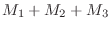
We see that parallel comb filters require more delay memory ( $ M_1+M_2+M_3$ elements) than the corresponding TDL, which only requires $ \max(M_1,M_2,M_3)$ elements.

Order a Hardcopy of Physical Audio Signal Processing

Previous: Filtered-Feedback Comb Filters
Next: Equivalence of Series Combs to TDLs

written by Julius Orion Smith III
Julius Smith's background is in electrical engineering (BS Rice 1975, PhD Stanford 1983). He is presently Professor of Music and Associate Professor (by courtesy) of Electrical Engineering at Stanford's Center for Computer Research in Music and Acoustics (CCRMA), teaching courses and pursuing research related to signal processing applied to music and audio systems. See http://ccrma.stanford.edu/~jos/ for details.


Comments


No comments yet for this page


Add a Comment
You need to login before you can post a comment (best way to prevent spam). ( Not a member? )