Householder Feedback Matrix
One choice of lossless feedback matrix
 for FDNs, especially
nice in the
for FDNs, especially
nice in the  case, is a specific Householder
reflection proposed by Jot [217]:
case, is a specific Householder
reflection proposed by Jot [217]:
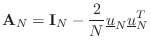
where
![$ \uv_N^T = [1, 1, \dots, 1]$](http://www.dsprelated.com/josimages_new/pasp/img756.png) can be interpreted as the specific
vector about which the input vector is reflected in
can be interpreted as the specific
vector about which the input vector is reflected in  -dimensional
space (followed by a sign inversion). More generally, the identity
matrix
-dimensional
space (followed by a sign inversion). More generally, the identity
matrix
 can be replaced by any
  permutation matrix
[153, p. 126].
permutation matrix
[153, p. 126].
It is interesting to note that when is a power of 2, no multiplies
are required [430]. For other , only one multiply is
required (by  ).
).
Another interesting property of the Householder reflection
given by Eq. (3.4) (and its permuted forms) is that an
matrix-times-vector operation may be carried out with only
(3.4) (and its permuted forms) is that an
matrix-times-vector operation may be carried out with only  additions (by first forming
  times the input vector, applying
the scale factor , and subtracting the result from the input
vector). This is the same computation as physical wave
scattering at a junction of identical waveguides (§C.8).
times the input vector, applying
the scale factor , and subtracting the result from the input
vector). This is the same computation as physical wave
scattering at a junction of identical waveguides (§C.8).
An example implementation of a Householder FDN for  is shown in
Fig.3.11. As observed by Jot [153, p.
216], this computation is equivalent to
parallel feedback comb filters with one new feedback path from the
output to the input through a gain of
is shown in
Fig.3.11. As observed by Jot [153, p.
216], this computation is equivalent to
parallel feedback comb filters with one new feedback path from the
output to the input through a gain of  .
.
![\includegraphics[width=0.7\twidth]{eps/householder1}](http://www.dsprelated.com/josimages_new/pasp/img762.png)
A nice feature of the Householder feedback matrix  is that
for
is that
for  , all entries in the matrix are nonzero. This
means every delay line feeds back to every other delay line, thereby
helping to maximize echo density as soon as possible.
, all entries in the matrix are nonzero. This
means every delay line feeds back to every other delay line, thereby
helping to maximize echo density as soon as possible.
Furthermore, for  , all matrix entries have the same
magnitude:
, all matrix entries have the same
magnitude:
![$\displaystyle \mathbf{A}_4 = \frac{1}{2}
\left[\begin{array}{rrrr}
1 & -1 & -1 ...
...
-1 & 1 & -1 & -1\\
-1 & -1 & 1 & -1\\
-1 & -1 & -1 & 1
\end{array}\right].
$](http://www.dsprelated.com/josimages_new/pasp/img766.png) case is ``balanced'' in this way. For larger , the
diagonal becomes larger than the off-diagonal elements, and as
becomes very large, the FDN approaches a bank of decoupled
parallel comb filters.
case is ``balanced'' in this way. For larger , the
diagonal becomes larger than the off-diagonal elements, and as
becomes very large, the FDN approaches a bank of decoupled
parallel comb filters.
Due to the elegant balance of the Householder feedback matrix,
Jot [216] proposes an  FDN based on an embedding of
feedback matrices:
FDN based on an embedding of
feedback matrices:
![$\displaystyle \mathbf{A}_{16} = \frac{1}{2}
\left[\begin{array}{rrrr}
\mathbf{A...
...\mathbf{A}_4 & -\mathbf{A}_4 & -\mathbf{A}_4 & \mathbf{A}_4
\end{array}\right]
$](http://www.dsprelated.com/josimages_new/pasp/img768.png) and contains four delay lines.
and contains four delay lines.
Next Section:
Householder Reflections
Previous Section:
Hadamard Matrix