Mode Density Requirement
A guide for the sum of the delay-line lengths is the desired
mode density. The sum of delay-line lengths  in a lossless
FDN is simply the order of the system
in a lossless
FDN is simply the order of the system  :
:
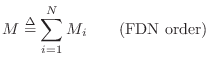
Since the order of a system equals the number of poles, we have that
is the number of poles on the unit circle in the lossless
prototype. If the modes were uniformly distributed, the mode density
would be  modes per Hz. Schroeder [417]
suggests that, for a reverberation time of 1 second, a mode density of
0.15 modes per Hz is adequate. Since the mode widths are inversely
proportional to reverberation time, the mode density for a
reverberation time of 2 seconds should be 0.3 modes per Hz, etc. In
summary, for a sufficient mode density in the frequency domain,
Schroeder's formula is
modes per Hz. Schroeder [417]
suggests that, for a reverberation time of 1 second, a mode density of
0.15 modes per Hz is adequate. Since the mode widths are inversely
proportional to reverberation time, the mode density for a
reverberation time of 2 seconds should be 0.3 modes per Hz, etc. In
summary, for a sufficient mode density in the frequency domain,
Schroeder's formula is
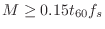
 )
equal to 1 second, we obtain
)
equal to 1 second, we obtain
 .
.
Next Section:
Prime Power Delay-Line Lengths
Previous Section:
Mean Free Path