







More General Velocity Excitations
From Eq. (E.11), it is clear that initializing any single K variable
 corresponds to the initialization of an infinite number of W
variables
corresponds to the initialization of an infinite number of W
variables
 and
and
 . That is, a single K variable
corresponds to only a single column of
. That is, a single K variable
corresponds to only a single column of
 for only one of the
interleaved grids. For example,
referring to Eq.(E.11),
initializing the K variable
for only one of the
interleaved grids. For example,
referring to Eq.(E.11),
initializing the K variable
 to -1 at time
  (with all other intialized to 0)
corresponds to the W-variable initialization
(with all other intialized to 0)
corresponds to the W-variable initialization
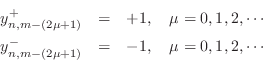
with all other W variables being initialized to zero.
In view of earlier remarks, this corresponds to an impulsive velocity
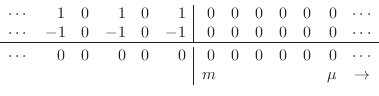
excitation on only one of the two subgrids. A schematic
depiction from  to
to  of the W variables at time is as
follows:
of the W variables at time is as
follows:
 |
(E.14) |
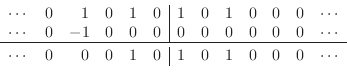
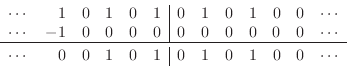
Below the solid line is the sum of the left- and right-going traveling-wave components, i.e., the corresponding K variables at time
. The vertical lines divide positions  and
and  .
The initial displacement is zero everywhere at time ,
consistent with an initial velocity excitation.
At times
.
The initial displacement is zero everywhere at time ,
consistent with an initial velocity excitation.
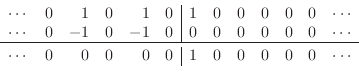
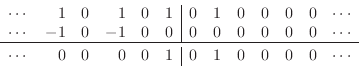
At times
 , the configuration evolves as follows:
 |
(E.15) |
 |
(E.16) |
 |
(E.17) |
 |
(E.18) |
The sequence
![$ [\dots,1,0,1,0,1,\dots]$](http://www.dsprelated.com/josimages_new/pasp/img4578.png) consists of a dc
(zero-frequency) component with amplitude
consists of a dc
(zero-frequency) component with amplitude  , plus a sampled
sinusoid of amplitude oscillating at half the sampling rate
, plus a sampled
sinusoid of amplitude oscillating at half the sampling rate
 . The dc component is physically correct for an initial
velocity point-excitation (a spreading square pulse on the string is
expected). However, the component at
. The dc component is physically correct for an initial
velocity point-excitation (a spreading square pulse on the string is
expected). However, the component at  is usually regarded as
an artifact of the finite difference scheme. From the DW
interpretation of the FDTD scheme, which is an exact, bandlimited
physical interpretation, we see that physically the component at
comes about from initializing velocity on only one of the two
interleaved subgrids of the FDTD scheme. Any asymmetry in the
excitation of the two interleaved grids will result in excitation of
this frequency component.
is usually regarded as
an artifact of the finite difference scheme. From the DW
interpretation of the FDTD scheme, which is an exact, bandlimited
physical interpretation, we see that physically the component at
comes about from initializing velocity on only one of the two
interleaved subgrids of the FDTD scheme. Any asymmetry in the
excitation of the two interleaved grids will result in excitation of
this frequency component.
Due to the independent interleaved subgrids in the FDTD algorithm, it is nearly always non-physical to excite only one of them, as the above example makes clear. It is analogous to illuminating only every other pixel in a digital image. However, joint excitation of both grids may be accomplished either by exciting adjacent spatial samples at the same time, or the same spatial sample at successive times instants.
In addition to the W components being non-local, they can demand a
larger dynamic range than the K variables. For example, if the entire
semi-infinite string for  is initialized with velocity
  ,
the initial displacement traveling-wave components look as follows:
,
the initial displacement traveling-wave components look as follows:
 |
(E.19) |
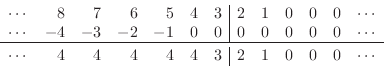
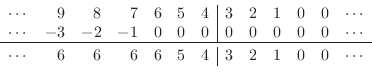
and the variables evolve forward in time as follows:
 |
(E.20) |
 |
(E.21) |
 |
(E.22) |
Thus, the left semi-infinite string moves upward at a constant velocity of 2, while a ramp spreads out to the left and right of position
at speed  , as expected physically. By
Eq.(E.9), the corresponding initial FDTD state for this case is
, as expected physically. By
Eq.(E.9), the corresponding initial FDTD state for this case is
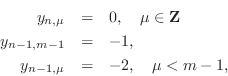
where  denotes the set of all integers.
While the FDTD excitation is also not local, of course, it is
bounded for all
denotes the set of all integers.
While the FDTD excitation is also not local, of course, it is
bounded for all  .
.
Since the traveling-wave components of initial velocity excitations are generally non-local in a displacement-based simulation, as illustrated in the preceding examples, it is often preferable to use velocity waves (or force waves) in the first place [447].
Another reason to prefer force or velocity waves is that displacement
inputs are inherently impulsive. To see why this is so, consider that
any physically correct driving input must effectively exert some
finite force on the string, and this force is free to change
arbitrarily over time. The ``equivalent circuit'' of the infinitely
long string at the driving point is a ``dashpot'' having real,
positive resistance
 . The applied force
  can be
divided by
can be
divided by  to obtain the velocity
  of the string driving
point, and this velocity is free to vary arbitrarily over time,
proportional to the applied force. However, this velocity must be
time-integrated to obtain a displacement
of the string driving
point, and this velocity is free to vary arbitrarily over time,
proportional to the applied force. However, this velocity must be
time-integrated to obtain a displacement  . Therefore,
there can be no instantaneous displacement response to a finite
driving force. In other words, any instantaneous effect of an input
driving signal on an output displacement sample is non-physical except
in the case of a massless system. Infinite force is required to move
the string instantaneously. In sampled displacement simulations, we
must interpret displacement changes as resulting from time-integration
over a sampling period. As the sampling rate increases, any
physically meaningful displacement driving signal must converge to
zero.
. Therefore,
there can be no instantaneous displacement response to a finite
driving force. In other words, any instantaneous effect of an input
driving signal on an output displacement sample is non-physical except
in the case of a massless system. Infinite force is required to move
the string instantaneously. In sampled displacement simulations, we
must interpret displacement changes as resulting from time-integration
over a sampling period. As the sampling rate increases, any
physically meaningful displacement driving signal must converge to
zero.
Next Section:
Additive Inputs
Previous Section:
Localized Velocity Excitations












