







Poles at 
We know from the above that the denominator of the cone reflectance
has at least one root at . In this subsection we investigate
this ``dc behavior'' of the cone more thoroughly.
A hasty analysis based on the reflection and transmission filters in
Equations (C.154) and (C.155) might conclude that the reflectance
of the conical cap converges to  at dc, since
  and
and  .
However, this would be incorrect. Instead, it is necessary to take the
limit as
.
However, this would be incorrect. Instead, it is necessary to take the
limit as
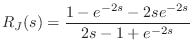
 of the complete conical cap reflectance
  :
:
 |
(C.165) |
We already discovered a root at
in the denominator in the context of
the preceding stability proof. However, note that the numerator also goes
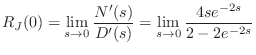
to zero at . This indicates a pole-zero cancellation at dc. To find
the reflectance at dc, we may use L'Hospital's rule to obtain
 |
(C.166) |
and once again the limit is an indeterminate
 form.
We therefore apply L'Hospital's rule again to obtain
form.
We therefore apply L'Hospital's rule again to obtain
 |
(C.167) |
Thus, two poles and zeros cancel at dc, and the dc reflectance is
 , not
as an analysis based only on the scattering filters would indicate.
From a physical point of view, it makes more sense that the cone should
``look like'' a simple rigid termination of the cylinder at dc, since its
length becomes small compared with the wavelength in the limit.
, not
as an analysis based only on the scattering filters would indicate.
From a physical point of view, it makes more sense that the cone should
``look like'' a simple rigid termination of the cylinder at dc, since its
length becomes small compared with the wavelength in the limit.
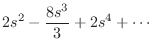
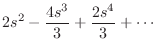
Another method of showing this result is to form a Taylor series expansion
of the numerator and denominator:
 |
 |
 |
(C.168) |
 |
|
 |
(C.169) |
Both series begin with the term
 which means both the numerator
and denominator have two roots at . Hence, again the conclusion
is two pole-zero cancellations at dc. The series for the conical cap
reflectance can be shown to be
which means both the numerator
and denominator have two roots at . Hence, again the conclusion
is two pole-zero cancellations at dc. The series for the conical cap
reflectance can be shown to be
 |
(C.170) |
which approaches
as  .
.
An alternative analysis of this issue is given by Benade in [37].
Next Section:
A Class of Well Posed Damped PDEs
Previous Section:
Reflectance Magnitude












