







Rigid Terminations
A rigid termination is the simplest case of a string (or tube)
termination. It imposes the constraint that the string (or air) cannot move
at the termination. (We'll look at the more practical case of a yielding
termination in §9.2.1.) If we terminate a length  ideal string at
 and
and  , we then have the ``boundary conditions''

where ``
 '' means ``identically equal to,'' i.e., equal for all
 . Let
. Let
 denote the time in samples to propagate
from one end of the string to the other and back, or the total
``string loop'' delay. The loop delay
denote the time in samples to propagate
from one end of the string to the other and back, or the total
``string loop'' delay. The loop delay  is also equal to twice the
number of spatial samples along the string.
is also equal to twice the
number of spatial samples along the string.
Applying the traveling-wave decomposition from Eq. (6.2), we have

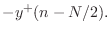
Therefore, solving for the reflected waves gives
 |
 |
 |
(7.10) |
 |
|
 |
(7.11) |
A digital simulation diagram for the rigidly terminated ideal string is shown in Fig.6.3. A ``virtual pickup'' is shown at the arbitrary location
 .
.
![\includegraphics[width=\twidth]{eps/fterminatedstring}](http://www.dsprelated.com/josimages_new/pasp/img1360.png) |
Velocity Waves at a Rigid Termination
Since the displacement is always zero at a rigid termination, the velocity is also zero there:



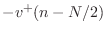
Such inverting reflections for velocity waves at a rigid termination are identical for models of vibrating strings and acoustic tubes.
Force or Pressure Waves at a Rigid Termination
To find out how force or pressure waves recoil from a rigid
termination, we may convert velocity waves to force or velocity waves
by means of the Ohm's law relations of Eq.(6.6) for strings
(or Eq.(6.7) for acoustic tubes), and then use
Eq.(6.12), and then Eq.(6.6) again:

Thus, force (and pressure) waves reflect from a rigid termination with no sign inversion:7.3
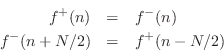
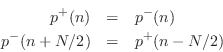
The reflections from a rigid termination in a digital-waveguide acoustic-tube simulation are exactly analogous:
Waveguide terminations in acoustic stringed and wind instruments are never perfectly rigid. However, they are typically passive, which means that waves at each frequency see a reflection coefficient not exceeding 1 in magnitude. Aspects of passive ``yielding'' terminations are discussed in §C.11.
Next Section:
Moving Rigid Termination
Previous Section:
Ideal Acoustic Tube












