







Scattering Filters at the Cylinder-Cone Junction
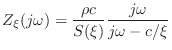
As derived in §C.18.4, the wave impedance (for volume velocity)
at frequency  rad/sec in a converging cone is given by
 |
(C.152) |
where
 is the distance to the apex of the cone,
  is the
cross-sectional area, and
is the
cross-sectional area, and  is the wave impedance in open air. A
cylindrical tube is the special case
is the wave impedance in open air. A
cylindrical tube is the special case
 , giving
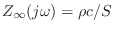 , independent of position in the tube. Under
normal assumptions such as pressure continuity and flow conservation at the
cylinder-cone junction (see, e.g.,
[300]), the junction reflection transfer
function (reflectance) seen from the cylinder looking into the cone is
derived to be
, independent of position in the tube. Under
normal assumptions such as pressure continuity and flow conservation at the
cylinder-cone junction (see, e.g.,
[300]), the junction reflection transfer
function (reflectance) seen from the cylinder looking into the cone is
derived to be
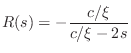
(where
 is the Laplace transform variable which generalizes
  )
while the junction transmission transfer function
(transmittance) to the right is given by
)
while the junction transmission transfer function
(transmittance) to the right is given by
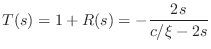
The reflectance and transmittance from the right of the junction are the same when there is no wavefront area discontinuity at the junction [300]. Both
 and
and  are first-order
transfer functions: They each have a single real pole at
are first-order
transfer functions: They each have a single real pole at
 .
Since this pole is in the right-half plane, it corresponds to an unstable
one-pole filter.
.
Since this pole is in the right-half plane, it corresponds to an unstable
one-pole filter.
Next Section:
Reflectance of the Conical Cap
Previous Section:
Cylindrical Tubes












