Reflectance of the Conical Cap
Let
 denote the time to propagate across the length of
the cone in one direction. As is well known [22], the reflectance
at the tip of an infinite cone is
denote the time to propagate across the length of
the cone in one direction. As is well known [22], the reflectance
at the tip of an infinite cone is  for pressure waves. I.e., it
reflects like an open-ended cylinder. We ignore any absorption losses
propagating in the cone, so that the transfer function from the entrance of
the cone to the tip is
for pressure waves. I.e., it
reflects like an open-ended cylinder. We ignore any absorption losses
propagating in the cone, so that the transfer function from the entrance of
the cone to the tip is
 . Similarly, the transfer function from
the conical tip back to the entrance is also
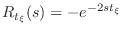
. The complete
reflection transfer function from the entrance to the tip and back is then
. Similarly, the transfer function from
the conical tip back to the entrance is also
. The complete
reflection transfer function from the entrance to the tip and back is then
 |
(C.155) |
Note that this is the reflectance a distance
 from a conical tip
inside the cone.
from a conical tip
inside the cone.
We now want to interface the conical cap reflectance
 to the
cylinder. Since this entails a change in taper angle, there will be
reflection and transmission filtering at the cylinder-cone junction given
by Eq.
to the
cylinder. Since this entails a change in taper angle, there will be
reflection and transmission filtering at the cylinder-cone junction given
by Eq. (C.154) and Eq.(C.155).
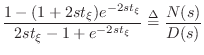
From inside the cylinder, immediately next to the cylinder-cone
junction shown in Fig.C.48, the reflectance of the conical cap is
readily derived from Fig.C.48b and Equations (C.154) and
(C.155) to be
 |
 |
 |
|
|
 |
(C.156) |
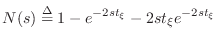
where
 |
(C.157) |
is the numerator of the conical cap reflectance, and
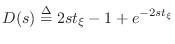 |
(C.158) |
is the denominator. Note that for very large
 , the conical
cap reflectance approaches
, the conical
cap reflectance approaches
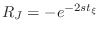 which coincides with
the impedance of a length
open-end cylinder, as expected.
which coincides with
the impedance of a length
open-end cylinder, as expected.
Next Section:
Stability Proof
Previous Section:
Scattering Filters at the Cylinder-Cone Junction