







Single-Input, Single-Output (SISO) FDN
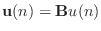
When there is only one input signal  , the input vector
 in Fig.2.28 can be defined as the scalar input times a
vector of gains:
in Fig.2.28 can be defined as the scalar input times a
vector of gains:
 is an
is an  matrix. Similarly, a single output can
be created by taking an arbitrary linear combination of the
matrix. Similarly, a single output can
be created by taking an arbitrary linear combination of the  components of
 . An example single-input, single-output (SISO)
FDN for
. An example single-input, single-output (SISO)
FDN for  is shown in Fig.2.29.
![\includegraphics[width=\twidth]{eps/FDNSISO}](http://www.dsprelated.com/josimages_new/pasp/img555.png)
Note that when
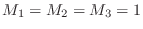 , this system is capable of realizing
any transfer function of the form
, this system is capable of realizing
any transfer function of the form
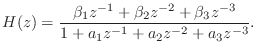
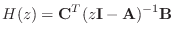
 denotes the
  identity matrix. This is easy
to show by taking the z transform of the impulse response of the system.
identity matrix. This is easy
to show by taking the z transform of the impulse response of the system.
The more general case shown in Fig.2.29 can be handled in one of
two ways: (1) the matrices
 can be augmented
to order
can be augmented
to order
 such that the three delay lines are replaced
by unit-sample delays, or (2) ordinary state-space analysis
may be generalized to non-unit delays, yielding
such that the three delay lines are replaced
by unit-sample delays, or (2) ordinary state-space analysis
may be generalized to non-unit delays, yielding
![$\displaystyle H(z) = \mathbf{C}^T \mathbf{D}(z)\left[\mathbf{I}- \mathbf{A}\mathbf{D}(z)\right]^{-1}\mathbf{B}
$](http://www.dsprelated.com/josimages_new/pasp/img562.png)
 denotes the matrix transpose of
 , and
, and
![$\displaystyle \mathbf{D}(z) \isdef \left[\begin{array}{ccc} z^{-M_1} & 0 & 0\\ [2pt] 0 & z^{-M_2} & 0\\ [2pt] 0 & 0 & z^{-M_3} \end{array}\right]. \protect$](http://www.dsprelated.com/josimages_new/pasp/img539.png)
In FDN reverberation applications,
 , where
 is an orthogonal matrix, for reasons addressed below, and
 is a
diagonal matrix of lowpass filters, each having gain bounded by 1. In
certain applications, the subset of orthogonal matrices known as
circulant matrices have advantages [385].
is a
diagonal matrix of lowpass filters, each having gain bounded by 1. In
certain applications, the subset of orthogonal matrices known as
circulant matrices have advantages [385].
Next Section:
FDN Stability
Previous Section:
FDN and State Space Descriptions












