Wave Equation in Higher Dimensions
The wave equation in 1D, 2D, or 3D may be written as
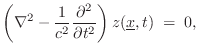
where, in 3D,
 denotes the amplitude of the wave at time
  and position
 , and
, and

 .)
To investigate solutions of the wave equation, as pursued in
§B.8.3 below, it is useful to first develop some simple
expressions and notations for elementary waves in 2D and 3D.
.)
To investigate solutions of the wave equation, as pursued in
§B.8.3 below, it is useful to first develop some simple
expressions and notations for elementary waves in 2D and 3D.
Plane Waves in Air
Figure B.9 shows a 2D  cross-section of a snapshot (in time)
of the sinusoidal plane wave
cross-section of a snapshot (in time)
of the sinusoidal plane wave

 and
and
 , with
  and
and  in the range
  .
.
![\includegraphics[width=\twidth]{eps/planewave}](http://www.dsprelated.com/josimages_new/pasp/img3149.png) |
 , at
, at ![$ \underline{k}^T=[10\pi, 5\pi, 0]$](http://www.dsprelated.com/josimages_new/pasp/img3148.png) .
.Figure B.10 depicts a more mathematical schematic of a sinusoidal plane wave traveling toward the upper-right of the figure. The dotted lines indicate the crests (peak amplitude location) along the wave.
 plane.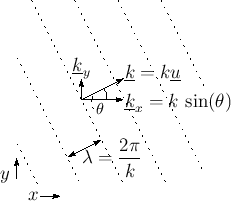
The direction of travel and spatial frequency are indicated by the
vector wavenumber
 , as discussed in in the following section.
Vector Wavenumber
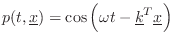
Mathematically, a sinusoidal plane wave, as in Fig.B.9 or Fig.B.10, can be written as

where p(t,x) is the pressure at time
(seconds) and position
(3D Euclidean space). The amplitude  , phase
 , and radian frequency
  are ordinary sinusoid parameters
[451], and
is the vector wavenumber:
are ordinary sinusoid parameters
[451], and
is the vector wavenumber:
![$\displaystyle \underline{k}\eqsp \left[\begin{array}{c} k_x \\ [2pt] k_y \\ [2p...
... \cos{\beta} \\ [2pt] \cos{\gamma}\end{array}\right] \isdefs k\,\underline{u},
$](http://www.dsprelated.com/josimages_new/pasp/img3153.png)
-
 (unit) vector of direction cosines
-
 (scalar) wavenumber along travel
direction
(scalar) wavenumber along travel
direction
 contains
- wavenumber along the travel direction in its magnitude

- travel direction in its orientation

To see that the vector wavenumber
has the claimed
properties, consider that the orthogonal projection of any
vector
 onto a vector collinear with
 is given by
 [451].B.35Thus,
is the component of
lying along the
direction of wave propagation indicated by
. The norm of this
component is
[451].B.35Thus,
is the component of
lying along the
direction of wave propagation indicated by
. The norm of this
component is
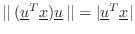 , since
is
unit-norm by construction. More generally,
, since
is
unit-norm by construction. More generally,
 is the
signed length (in meters) of the component of
along
.
This length times wavenumber
is the
signed length (in meters) of the component of
along
.
This length times wavenumber  gives the spatial phase advance along
the wave, or,
gives the spatial phase advance along
the wave, or,
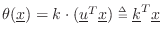 .
.
For another point of view, consider the plane wave
 ,
which is the varying portion of the general plane-wave of
Eq.
,
which is the varying portion of the general plane-wave of
Eq. (B.48) at time
  , with unit amplitude
  and zero phase
 . The spatial phase of this plane wave is given by

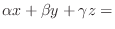 constant
 ,
,  , and
, and  are real constants, and ,
, and
are real constants, and ,
, and  are 3D spatial coordinates. Thus, the set of all points
 yielding the same value
 define a
plane of constant phase
define a
plane of constant phase  in
in  .
.
As we know from elementary vector calculus, the direction of maximum
phase advance is given by the gradient of the phase
 :
:
![$\displaystyle \underline{\nabla }\theta(\underline{x}) \isdefs
\left[\begin{ar...
...rray}{c} k_x \\ [2pt] k_y \\ [2pt] k_z\end{array}\right] \isdefs \underline{k}
$](http://www.dsprelated.com/josimages_new/pasp/img3172.png) is equal to the gradient
of the phase
, so that
points in the direction of
maximum spatial-phase advance.
is equal to the gradient
of the phase
, so that
points in the direction of
maximum spatial-phase advance.
Since the wavenumber is the spatial frequency (in radians per
meter) along the direction of travel, we should be able to compute it
as the directional derivative of
along
,
i.e.,


Scattering of plane waves is discussed in §C.8.1.
Solving the 2D Wave Equation
Since solving the wave equation in 2D has all the essential features of the 3D case, we will look at the 2D case in this section.
Specializing Eq.(B.47) to 2D, the 2D wave equation may
be written as
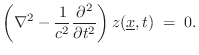
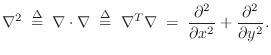
The 2D wave equation is obeyed by traveling sinusoidal plane
waves having any amplitude , radian frequency , phase
, and direction
:
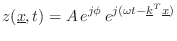
 denotes the vector-wavenumber,
 denotes
the wavenumber (spatial radian frequency) of the wave along its
direction of travel, and
is a unit vector of direction
cosines. This is the analytic-signal form of a sinusoidal
traveling plane wave, and we may define the real (physical) signal as
the real part of the analytic signal, as usual [451].
We see that the only constraint imposed by the wave equation on this
general traveling-wave is the so-called dispersion relation:
denotes
the wavenumber (spatial radian frequency) of the wave along its
direction of travel, and
is a unit vector of direction
cosines. This is the analytic-signal form of a sinusoidal
traveling plane wave, and we may define the real (physical) signal as
the real part of the analytic signal, as usual [451].
We see that the only constraint imposed by the wave equation on this
general traveling-wave is the so-called dispersion relation:
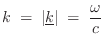 is tied to its temporal frequency by
the dispersion relation.B.36
is tied to its temporal frequency by
the dispersion relation.B.36
The sum of two such waves traveling in opposite directions with the
same amplitude and frequency produces a standing wave. For example,
if the waves are traveling parallel to the axis, we have

which is a standing wave along
.
2D Boundary Conditions
We often wish to find solutions of the 2D wave equation that obey
certain known boundary conditions. An example is transverse
waves on an ideal elastic membrane, rigidly clamped on its boundary to
form a rectangle with dimensions  meters.
Similar to the derivation of Eq.(B.49), we can subtract
the second sinusoidal traveling wave from the first to yield
 axis. If we restrict the wavenumber to the set
  , where
 is any positive integer, then we also satisfy the boundary
condition along the line parallel to the axis at
is any positive integer, then we also satisfy the boundary
condition along the line parallel to the axis at  . Similar
standing waves along will satisfy both boundary conditions along
. Similar
standing waves along will satisfy both boundary conditions along
 and
and  .
.
Note that we can also use products of horizontal and vertical standing waves
 , the
term
, the
term  is simply part of the constant coefficient, and vice
versa.
is simply part of the constant coefficient, and vice
versa.
To build solutions to the wave equation that obey all of the boundary conditions, we can form linear combinations of the above standing-wave products having zero displacement (``nodes'') along all four boundary lines:

where
 (B.50)
are solutions of the wave equation that satisfy the zero boundary
conditions along the rectangle
(B.50)
are solutions of the wave equation that satisfy the zero boundary
conditions along the rectangle  -
- -
- . Since sinusoids at
different frequencies are orthogonal,
the solution building-blocks
. Since sinusoids at
different frequencies are orthogonal,
the solution building-blocks
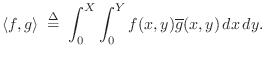
 are orthogonal under the
inner product
are orthogonal under the
inner product
 is
complete, that is, that they form a basis for the set of
all solutions to the wave equation satisfying the boundary
conditions. Given that, we can solve the problem of arbitrary
initial conditions. That is, given any initial
is
complete, that is, that they form a basis for the set of
all solutions to the wave equation satisfying the boundary
conditions. Given that, we can solve the problem of arbitrary
initial conditions. That is, given any initial  over the
membrane (subject to the boundary conditions, of course), we can find
the amplitude of each excited mode by simple projection:
over the
membrane (subject to the boundary conditions, of course), we can find
the amplitude of each excited mode by simple projection:
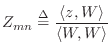 in the desired solution
space is a special case (zero boundary conditions) of the problem of
showing that the 2D Fourier series expansion is complete in the space
of all continuous rectangular surfaces.
in the desired solution
space is a special case (zero boundary conditions) of the problem of
showing that the 2D Fourier series expansion is complete in the space
of all continuous rectangular surfaces.
The Wikipedia page (as of 1/31/10) on the Helmholtz equation provides a nice ``entry point'' on the above topics and further information.
3D Sound
The mathematics of 3D sound is quite elementary, as we will see below. The hard part of the theory of practical systems typically lies in the mathematical approximation to the ideal case. Examples include Ambisonics [158] and wave field synthesis [49].
Consider a point source at position
 . Then the
acoustic complex amplitude at position
. Then the
acoustic complex amplitude at position
 is given by
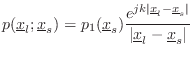
 denotes the complex amplitude one meter from the
point source in any direction, and
denotes the complex amplitude one meter from the
point source in any direction, and
 denotes the wavenumber
(spatial radian frequency). Distributed acoustic sources are
handled as a superposition of point sources, so the point source is a
completely general building block for all types of sources in linear
acoustics.
denotes the wavenumber
(spatial radian frequency). Distributed acoustic sources are
handled as a superposition of point sources, so the point source is a
completely general building block for all types of sources in linear
acoustics.
The fundamental approximation problem in 3D sound is to approximate
the complex acoustic field at one or more listening points using a
finite set of  loudspeakers, which are often modeled as a point
source for each speaker.
loudspeakers, which are often modeled as a point
source for each speaker.
Next Section:
The Ideal Vibrating String
Previous Section:
Properties of Gases